Mantra · For expansiveness and freedom from constraint.
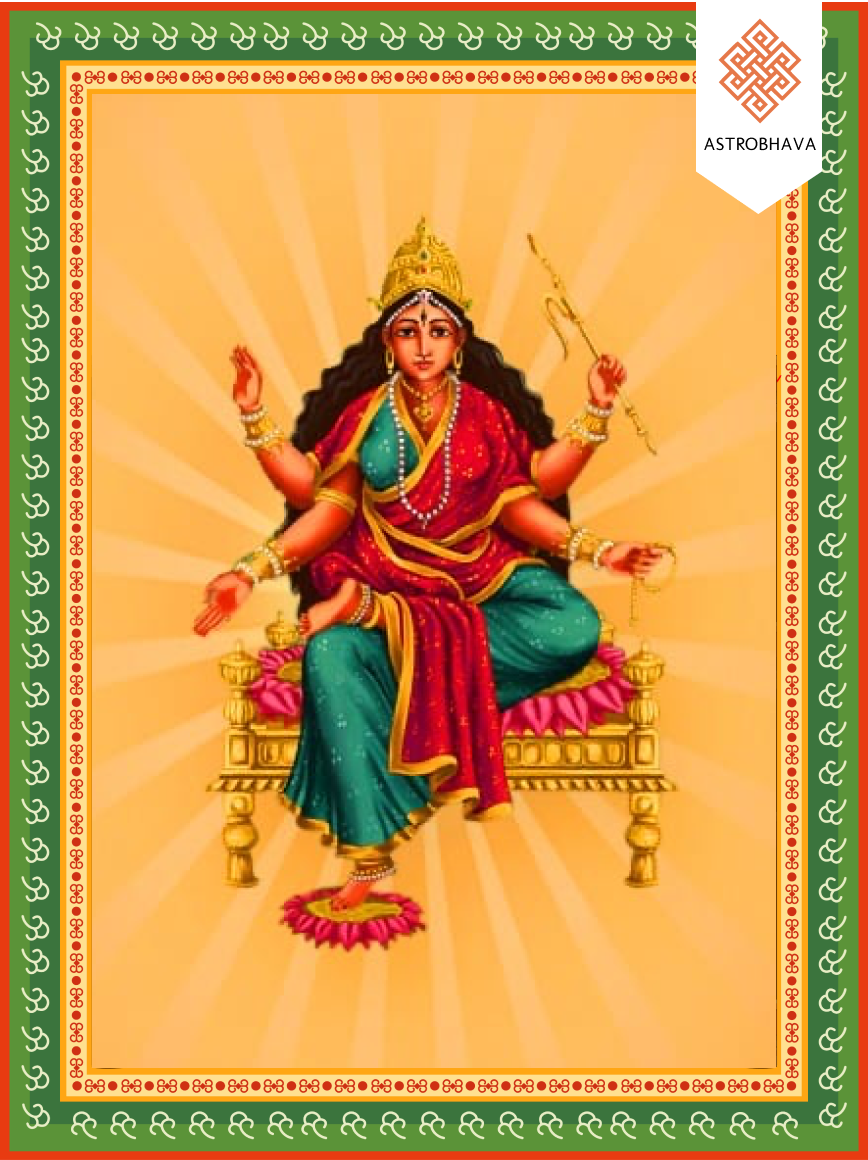
Bhuvaneshwari
ॐ ह्रीं भुवनेश्वर्यै नमः
In Devanagari, Tamil, Telugu, Kannada, Malayalam and English — with the meaning of every word, and the one syllable most people pronounce wrongly.
Who Bhuvaneshwari is
Bhuvaneshwari is the Mahavidya who personifies the expanse of the worlds themselves. Her name compounds bhuvana, meaning realm or being, with ishvari, the feminine sovereign. Among the ten great wisdom goddesses she occupies the place of the spatial matrix in which every other form appears. Tantric sources such as the Todala Tantra and the Jnanarnava Tantra describe her as the colour of the rising sun, holding the noose and the goad, making the gestures of boon and fearlessness, and seated upon a lotus that floats in the causal waters. She is not a warrior like Chandi nor a destroyer like Kali; her sovereignty is the quiet fact that nothing exists outside her. In the Sri Vidya stream she is sometimes aligned with pure samvit, the awareness that is the ground of the Sri Chakra, yet she retains independent worship as the fourth Mahavidya whose body is the cosmos.
The Space That Holds Forms
According to the Mahavidya cycle preserved in several tantras and in later elaborations of the Devi Bhagavata Purana, the ten forms arise when the Goddess reveals the full spectrum of her power. Bhuvaneshwari’s particular revelation is the demonstration that the universe is her own body. One account relates that when the worlds contracted in fear or ignorance she expanded her form until every bhuvana, from the highest satyaloka to the nether realms, was seen to rest within her. Another strand, found in the Bhuvaneshwari Rahasya and related paddhatis, presents her as the origin of the three cities that Tripurasundari later rules; before there can be a tripura there must be the bhuvana that contains it. Her myth is therefore less an episode of combat than a disclosure of containment: the Goddess shows that what beings take to be external space is simply the openness of her own being. This disclosure becomes the contemplative heart of her worship in the tantric lineages that transmit her mantra.
The mantra, in six scripts
The seed mantra, and the form most devotees chant daily. No initiation is required — it is open to anyone, including a parent chanting for a child.
“Om, the seed-syllable hrim, salutations to the sovereign of the worlds.”
ॐ
oṃ — the sacred syllable
ह्रीं
hrīṃ — the māyā-bīja of the Goddess
भुवनेश्वर्यै
bhuvaneśvaryai — to Bhuvaneshwari, sovereign of the realms
नमः
namaḥ — salutations
Aim is the mantra, in a sense. The rest is address and salutation; the seed syllable carries the goddess. Where a practitioner has been given a very short practice, it is often Aim alone.
The syllable people get wrong
In bhuvaneśvaryai the consonant cluster śv is often pronounced as a simple English shw, flattening the palatal ś into a postalveolar sound and losing the slight labial glide. The correct ś places the tongue against the hard palate while the following v remains light. Equally common is the reduction of the final dative ending yai to a short i, so the name is heard as bhuvaneshwari rather than bhuvaneśvaryai.
When Bhuvaneshwari is chanted
Weekday. Friday
Questions
Bhuvana denotes a world or a level of existence; ishvari is the feminine of ishvara, the ruler. The compound therefore means the female sovereign of the worlds, the one within whose being every realm is situated.
She is counted as the fourth of the ten Mahavidyas. While Kali and Tara embody time and the star of guidance, Bhuvaneshwari embodies the spatial expanse that makes manifestation possible; the remaining Mahavidyas arise within the field she provides.
Hrim is the maya-bija, the sound that both veils and reveals. Because Bhuvaneshwari is the very field in which veiling and revealing occur, the tantras assign hrim to her as her principal seed-syllable.
Not sure a mantra is enough?
Have your chart read before you decide
Chanting is yours to do, and free. But which deity your situation calls for — and whether a mantra alone is the right response — depends on your chart. Sometimes it is; sometimes it is not.
Brahmashree Shivaaya
Guru, Head of Astrological & Spiritual Solutions
Over 30 years in the Guru–Sishya Parampara, from the age of five
He reads every chart himself — 60 minutes, one to one, never delegated
Charts are read only between sunrise and sunset, following tradition
Chanting is yours to do. Some things are performed for you.
Where a matter carries real weight — an examination that decides a course, a performance, a child whose studies have stalled — devotees sponsor the homa alongside their own practice. Performed individually at our Yagna Ashram in your name and gotra, on a muhurta calculated from your chart, and telecast live so you can watch it done for you.