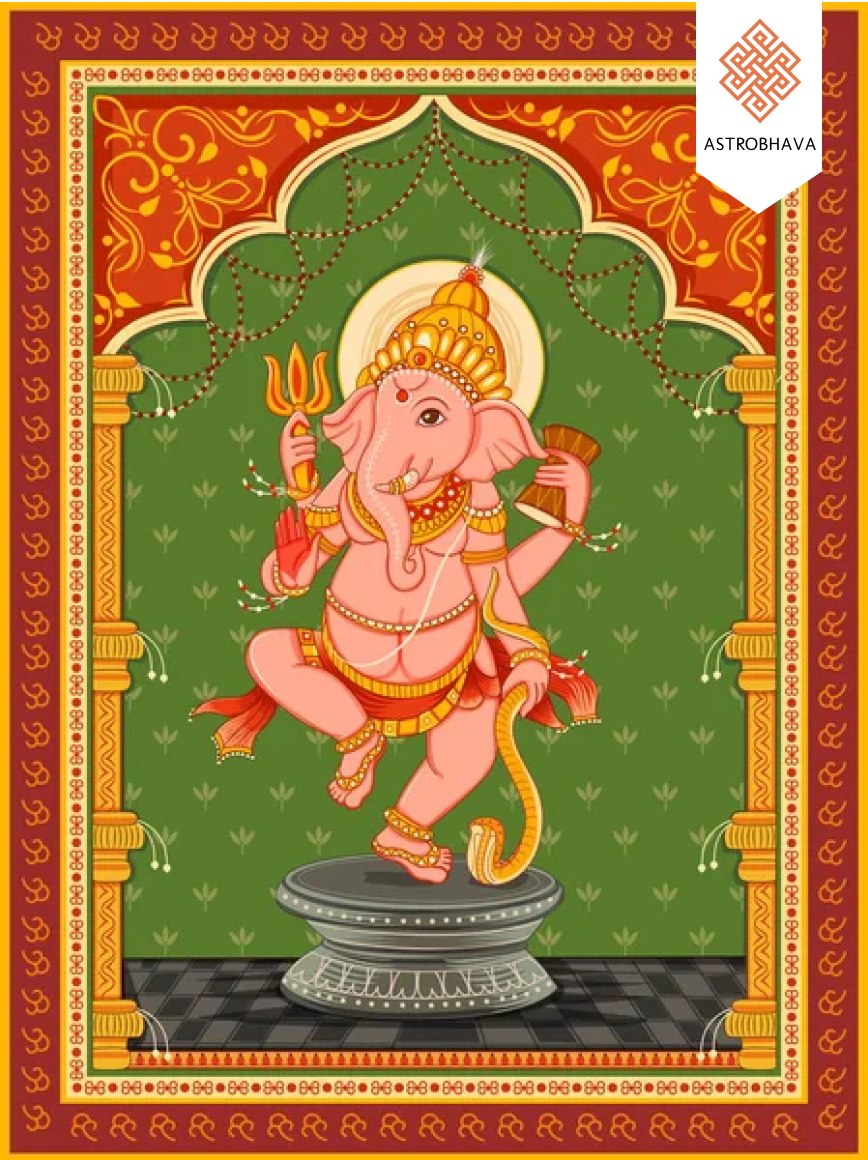
Mantra · The child form. For children's wellbeing and early education.
Bala Ganapathi
ॐ बालगणपतये नमः
In Devanagari, Tamil, Telugu, Kannada, Malayalam and English — with the meaning of every word, and the one syllable most people pronounce wrongly.
Who Bala Ganapathi is
Bala Ganapathi is Ganesha beheld in the measure of early childhood. The Mudgala Purana and the silpa texts that follow it describe him as small of stature, radiant with a reddish or golden glow, and holding in his hands the banana, the mango, the jackfruit, the sugarcane and the modaka—fruits and sweets that belong to the world of the young. He wears simple ornaments and a child’s top-knot or soft crown. Tradition turns to this form when the subject before the household is the child itself: the first years of life, the beginning of letters, the fragile stretch in which body and mind are still taking shape. He is not a diminished Ganesha but the deity as the principle of auspicious commencement, the same elephant-headed lord whose grace is sought at every threshold, now shown in the age that itself constitutes a threshold. His fivefold fruit offering marks him as the aspect whose concern is growth still close to the ground of infancy.
The Child among Thirty-two
Within the Mudgala Purana’s enumeration of the thirty-two forms, Bala Ganapathi stands as the manifestation of tender age. The text supplies no separate battle legend; it offers instead a precise iconographic and theological portrait. He is the colour of the rising sun, three-eyed, four-armed or sometimes five, and his hands display the very produce of the orchard and the kitchen that a child might reach for—banana, mango, jackfruit, sugarcane stem and the round sweet modaka. Commentarial tradition understands this cluster of soft, nourishing objects as the visual language of early growth. Later paddhatis in the Tamil and Telugu countries preserve the same description without grafting onto it an independent narrative of origin. The form is therefore received as scripture’s way of saying that the remover of obstacles may be contemplated at the scale of the child, and that the obstacles proper to that scale—those that attend the first steps of learning and the unprotected years—are already within his governance. The absence of a dramatic episode is itself instructive: Bala Ganapathi is less a hero of a single deed than the permanent child-face of the deity who sits at every beginning.
The mantra, in six scripts
The seed mantra, and the form most devotees chant daily. No initiation is required — it is open to anyone, including a parent chanting for a child.
Aim is the mantra, in a sense. The rest is address and salutation; the seed syllable carries the goddess. Where a practitioner has been given a very short practice, it is often Aim alone.
The syllable people get wrong
The long vowel ā in bāla is the syllable most often lost. Speakers reduce it to a short a, producing ‘bala’ with the flat sound of the English word ‘butter’ rather than the open, sustained ‘bā’ that the form’s name requires. In proper recitation the ā must be held long enough for the ear to register the full quantity before the tongue moves to la; otherwise the word ceases to mean ‘child’ and becomes a different, shortened stem.
When Bala Ganapathi is chanted
Weekday. Tuesday
Questions
The Mudgala Purana and the silpa digests that depend on it assign to Bala Ganapathi five specific items: the banana, the mango, the jackfruit, the sugarcane and the modaka. These are not interchangeable with the weapons or the single lotus of other forms. Each is a soft, edible object associated with childhood nourishment and with the orchards of South India where the form is most carefully described. Temple images and domestic bronzes that omit any of the five, or that substitute a noose or goad in their place, are understood to have drifted from the textual prescription for this particular manifestation.
Tradition places the child form at the threshold of letters because the form itself is the threshold of age. The same deity who is invoked before any undertaking is here contemplated in the body of a child, so that the first undertaking—the acquisition of syllable and number—falls naturally within his regard. The Mudgala list does not narrate a scene of teaching; the association arises from the logic of the icon. When the household’s concern is the young learner, the face of Ganapati that scripture holds up is the face that is itself young.
The concise formula oṃ bālagaṇapataye namaḥ is the address traditionally reserved for Bala Ganapathi in the lists that accompany the thirty-two forms. Longer strings of seed-syllables are attached to other manifestations, notably Lakshmi Ganapathi. The brevity of the child-form mantra mirrors the simplicity of the icon: no petitionary clause, only the name and the salutation. Reciters who expand it with the seeds proper to other forms are understood to have left the specific territory of Bala and entered a different liturgical zone.
Not sure a mantra is enough?
Have your chart read before you decide
Chanting is yours to do, and free. But which deity your situation calls for — and whether a mantra alone is the right response — depends on your chart. Sometimes it is; sometimes it is not.
Brahmashree Shivaaya
Guru, Head of Astrological & Spiritual Solutions
Over 30 years in the Guru–Sishya Parampara, from the age of five
He reads every chart himself — 60 minutes, one to one, never delegated
Charts are read only between sunrise and sunset, following tradition
Chanting is yours to do. Some things are performed for you.
Where a matter carries real weight — an examination that decides a course, a performance, a child whose studies have stalled — devotees sponsor the homa alongside their own practice. Performed individually at our Yagna Ashram in your name and gotra, on a muhurta calculated from your chart, and telecast live so you can watch it done for you.