Also spelled Nadi Dosh Nivaran Homam
नाडी दोष निवारण होमWhen two charts share one Nadi, the elders pause. This fire is lit to soften that verdict and settle the planets that carry it.
Nadi is the last and heaviest of the eight kootas in Vedic match-making. It speaks of the subtle currents — Aadi, Madhya and Antya — that govern vitality and constitution. When bride and groom fall under the same Nadi, the horoscope is said to carry Nadi dosha, and eight of the thirty-six guna points fall away. The Nadi Dosh Nivaran Homa is the classical fire remedy the shastras prescribe for exactly this reading, offered as a Maha homa in the Dosha Nivarana tradition.
This is not a rite against anyone's birth star. It is a rite of balance. Through measured oblations to Maha Mrityunjaya, the presiding grace invoked for vitality and release from bondage, the priests address the planetary lords standing behind the Nadi reading and ask that their pressure be eased. Families book this nadi dosh nivaran puja before fixing a wedding date, and many also request the nadi dosh nivaran puja after marriage, when the dosha is discovered late. Both are traditional. The fire does not ask when you came to it.
ॐ त्र्यम्बकं यजामहे सुगन्धिं पुष्टिवर्धनम् । उर्वारुकमिव बन्धनान् मृत्योर्मुक्षीय माऽमृतात् ॥ We worship the three-eyed Lord who is fragrant and who nourishes all beings; as the ripe cucumber is freed from its stalk, may we be released from the bonds that hold us and not from immortality.Every household comes with its own reason. These are the intentions the tradition attaches to this homa.
The rite is prescribed to soften the eight-point Nadi mismatch that surfaces during horoscope matching, so the alliance may proceed with the elders' blessing.
Oblations are offered to the grahas standing behind the Nadi reading, in the classical order, so that no single planet dominates the chart's fabric.
Families turn to this nadi dosh pooja when friction, distance or repeated misunderstanding shadows a young household, asking for harmony between the two constitutions.
The tradition offers this homa to Maha Mrityunjaya seeking vitality, longevity and auspiciousness for the couple and the lineage they hope to raise.
Booked when the pandit's koota report flags Nadi dosha and the family wishes the remedy completed before the muhurat is set.
The nadi dosh nivaran puja after marriage is equally sanctioned, for couples who learned of the dosha only once the horoscopes were compared later.
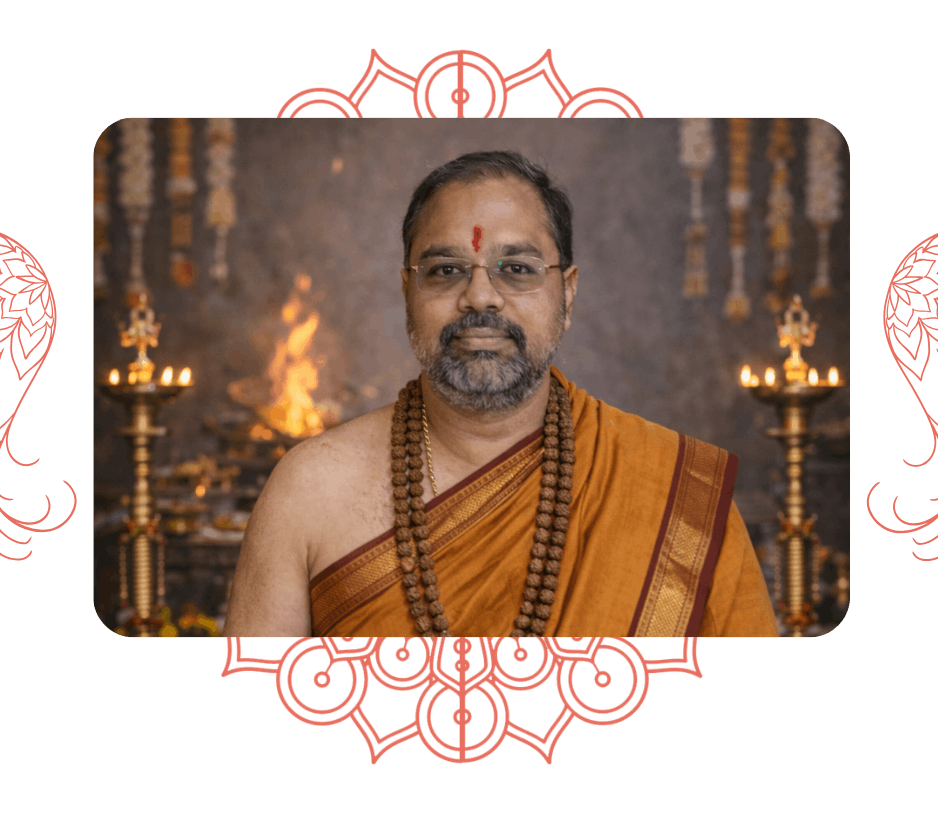
Every priest who performs your Nadi Dosh Nivaran Homa is trained in a traditional Padashala and personally recruited by Brahmashree Shivaaya — Guru and Head of Astrological & Spiritual Solutions at AstroBhava. Your ritual is conducted at our own Yagna Ashram — never a rented venue — with temple rites performed across our seven temples in Tamil Nadu and Kerala.
Meet our priests →Not every fire ritual is performed at the same scale. A Maha Homa is our largest form — more priests, a longer fire, and the complete chanting sequence the rite prescribes rather than an abridged one. This is what that means in practice.
A Maha Homa is performed for one devotee and their named family, the same as any homa we conduct. What the scale changes is the weight of the offering — ten trained voices holding one hymn for two hours is a different undertaking from one voice for an hour, and it is reserved for the intentions that warrant it.
Both packages are the same rite. The complete Nadi Dosh Nivaranm, all thirty-one verses, over approximately two hours, with the same offerings, the same free energised Surya Yantra sealed in its silver amulet, and the same live telecast. What changes is how many trained voices carry the hymn at once.
All prices are all-inclusive — no shipping charges, no additions at checkout. See everything included →
You book — and send birth details at checkout.
Within 24–48 working hours — your muhurta is confirmed by email.
The day before — your telecast link arrives by email.
After the homa — tracking email with your personal time to wear the yantra.
Our panchanga scholars fix the muhurat against your birth details. These are the windows the tradition favours for this homa.
Days sacred to Shiva are the natural seat of a Maha Mrityunjaya fire, and Pradosham twilight is held especially potent for dosha nivarana.
Nakshatras associated with healing and renewal are chosen when the calendar allows, for oblations aimed at the subtle Nadi currents.
Families schedule the homa in the weeks preceding the ceremony, once the koota matching is complete and the dosha has been read.
The waxing fortnight is preferred for rites of restoration, and Maha Shivaratri is regarded as the highest night for Mrityunjaya worship.
When your homa concludes, the yantra that stood in the fire is rolled and locked inside its silver amulet according to Agama vidhi — the practice by which the energies raised in a ritual are held within a consecrated object rather than dispersing. It is why a homa performed at our ashram can still reach a devotee ten thousand miles away: what the fire raised travels to you, sealed.
Your name, gotra & nakshatra — for you and up to five family members.
Watch your own homa in real time from the ashram. Streamed openly on our YouTube channel by default — or request a private, unlisted telecast at checkout.
Consecrated over three days — Jala (holy-water consecration with mantras), Prana (life force through pranayama & chants) and Jeeva Pratishta (awakened with 108 recitations & offerings) — then present through your homa, receiving the energies raised in the fire. Immediately afterwards it is rolled and sealed inside a silver amulet by Agamic rite, locking those energies within, and shipped to you with your prasadam.
Sacred vibhuti, sandalwood powder & kumkum from your fire — delivered to any country.
Daily temple worship for 48 days — the 27 Nakshatras + 12 Rashis + 9 Planets — then sealed in a silver amulet of approximately 2–4 inches.
As per strict Agama vidhi, no videography is permitted inside the temple sanctum — this preserves the pure sacred energies and undisturbed divine focus of the ritual. The main homa is respectfully telecast live from outside the sanctum; the daily rituals of the 48-day Anushthan are performed with full devotion but are not telecast.
Homas are telecast openly on our YouTube channel so that devotees everywhere may witness the rituals — and because we believe you should be able to see our work before you trust us with yours. Your sankalpa names you and your family, so if you would rather your ceremony were not public, choose the private telecast option at checkout and it is streamed as an unlisted link visible only to you.
We state this plainly — transparency about what tradition forbids filming, and about what is public, is part of performing these rituals honestly.
The energised yantra is carefully rolled and sealed inside a sacred silver amulet before shipping. Wearing it is itself a small ritual — and even its timing is set for you personally.
Our astrologer marks the auspicious date and time to wear the yantra according to your birth details — sent to you in the email carrying your shipment's tracking number.
Dip the silver amulet in raw milk or Ganga jal for an hour before wearing, then clean with normal water.
Perform the wearing process facing east or north for maximum benefit.
Show lamp and incense to the amulet before wearing it.
Around your neck or waist, on a thread or chain.
Repeated offering of dheep and dhoop keeps the energisation alive.
Place the amulet at your puja altar, or keep it in your wallet.
The priest states your name, gotra and nakshatra — and those of up to five family members — with the intention this homa is performed for.
The customary invocation to Ganapati, clearing obstacles before the goddess is approached.
The fire is consecrated in the homa kunda and Agni invoked as the carrier of every offering that follows.
The Maha Mrityunjaya Sukta and Maha Mrityunjaya Gayatri are chanted, inviting the goddess's presence into the fire — by one, three or five priests as your package sets.
Ghee, white flowers, akshata and honey are offered in sequence with mantra — the offerings traditional to her worship.
The final complete offering seals the sankalpa stated at the opening.
Aarti is performed live on your telecast. Vibhuti, sandalwood powder, kumkum and your energised yantra are then packed and shipped free to your door.
Maha Mrityunjaya is one of the Tridevi and the mother of the Vedas — the presiding deity of knowledge, learning, memory, speech, music and every art. She is depicted in white upon a white lotus, holding the veena, a book, a rosary and a water pot, with the swan of discernment beside her.
In this homa, her grace — Maha Mrityunjaya Kataksham — is invoked through fire with your own name and birth details spoken in the sankalpa.
Her full mythology, the beeja mantra and Maha Mrityunjaya Gayatri word by word, and how devotees chant at home — on our Maha Mrityunjaya Mantra guide.
Read the Mantra Guide →Sarathi, our free AI ritual guide, recommends the traditional ritual for your situation instantly. For a full reading of your chart, book a live session with our astrologers — the fee is fully credited when you book any ritual.
Book your Nadi Dosh Nivaran Homa, watch it performed live from our Yagna Ashram, and receive your energised yantra anywhere in the world.
Choose Your Package