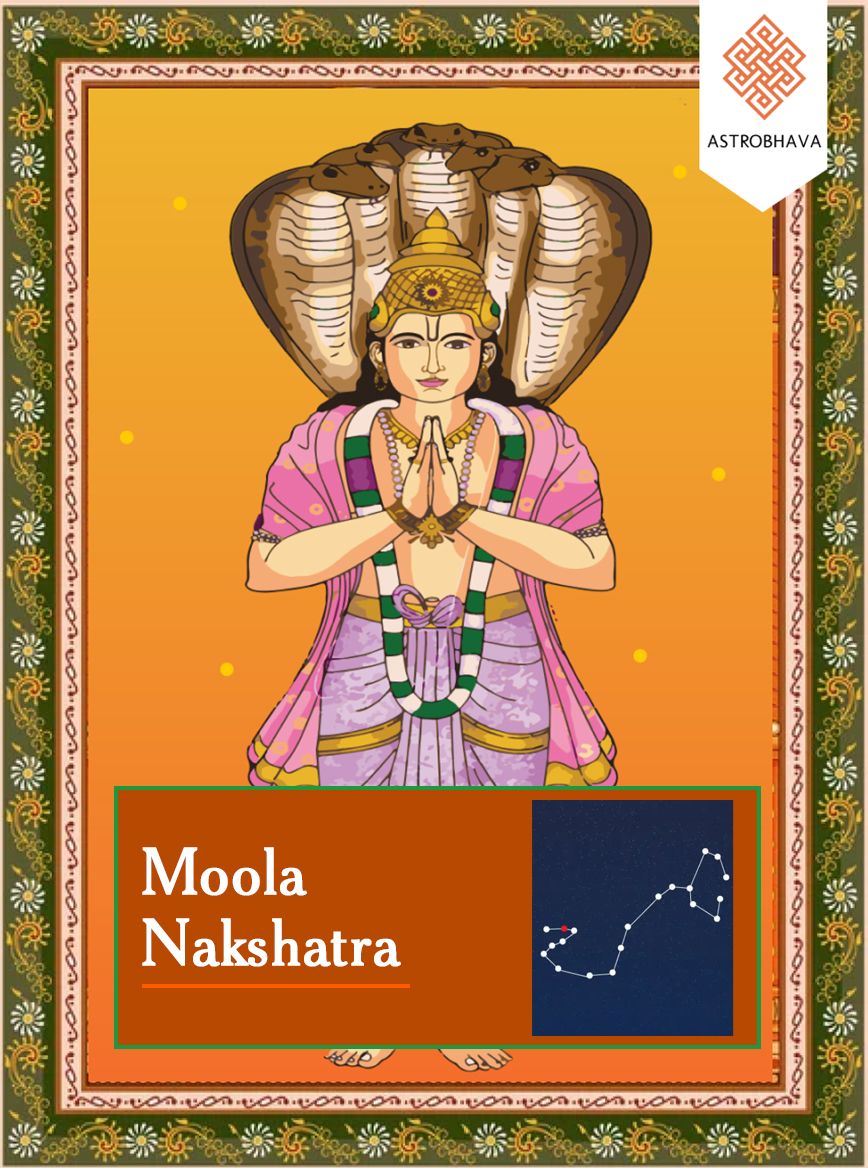
Moola means root. It is the nakshatra that sits at the heart of the galaxy, ruled by Ketu, presided over by Nirriti — the deity who governs dissolution, the cutting away of what has finished. A child born under Moola is born at a point of great intensity. The tradition does not read this as misfortune. It reads it as a star that asks for early consecration, the way strong soil asks for careful planting. The Moola Nakshatra Homa is that consecration, offered in fire.
The Moola Nakshatra Homam invokes Nirriti along with Ketu, the star's lord, and offers ghee, samidha and specific herbs into the kunda while the nakshatra's own mantras are chanted the prescribed number of times. Families book it for a newborn born in Moola, for a child before schooling or upanayanam, on the yearly return of the birth star, and during a Ketu dasha or bhukti. What is being asked for is alignment — that you and your birth star move in the same direction, so that its intensity works as depth rather than turbulence.
ॐ निरृतये नमः · Om Nirṛtaye Namaḥ · ಓಂ ನಿರೃತಯೇ ನಮಃ Salutations to Nirriti, presiding deity of the Moola star — may she dissolve what has outlived its use and guard the root of this life.
Why Devotees Book This
The tradition prescribes this homa for those whose janma nakshatra is Moola, and for the families who carry them. Here is what it is offered for.
Alignment with your birth star
The rite is timed and chanted to your own nakshatra, so the star you were born under is honoured rather than left unattended.
Protection for a newborn
Traditionally offered when a child is born in Moola, especially at the first return of the star, as a shanti for mother, child and household.
Steadiness during Ketu periods
Ketu rules Moola. Families turn to this homa when a Ketu dasha or antardasha begins and life feels uprooted.
Release of old entanglements
Nirriti is invoked to loosen knots — stalled matters, repeated patterns, attachments that no longer serve the household.
Prosperity that holds
Moola is the root. The offering asks that what you build stands on firm ground rather than shallow soil.
Clarity of direction
Moola natives are seekers by nature. The homa is offered so that searching becomes focus, not restlessness.
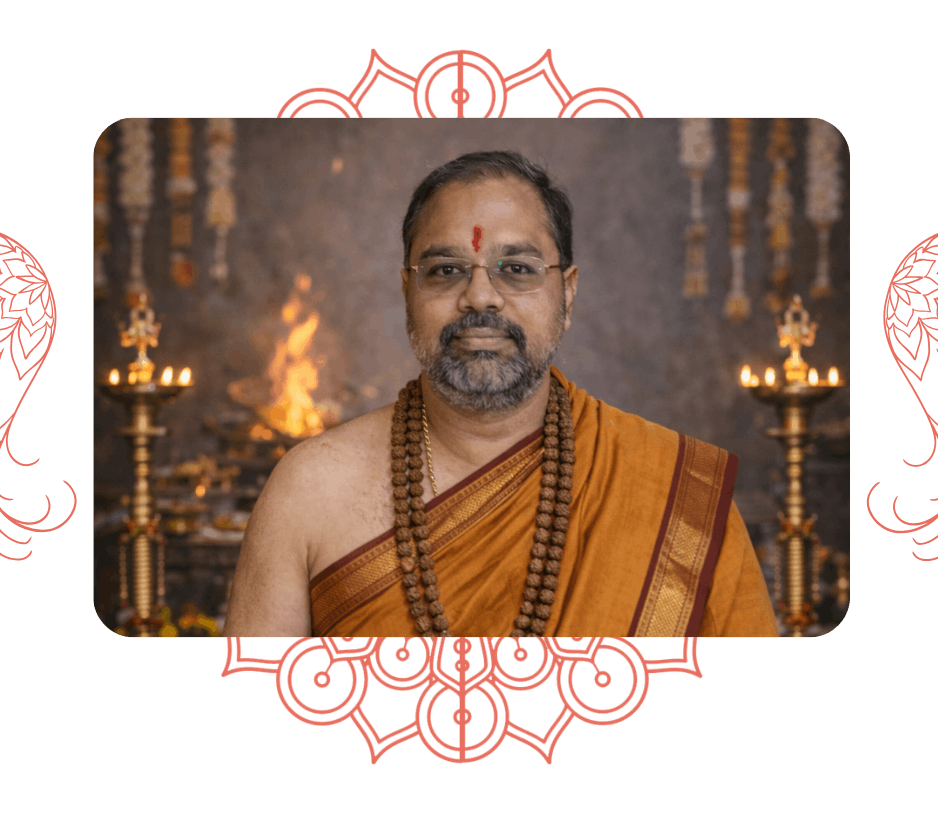
Brahmashree ShivaayaGuru, Head of Astrological & Spiritual Solutions
Who performs your homa
Under the guidance of Brahmashree Shivaaya
Every priest who performs your Moola Nakshatra Homa is trained in a traditional Padashala and personally recruited by Brahmashree Shivaaya — Guru and Head of Astrological & Spiritual Solutions at AstroBhava. Your ritual is conducted at our own Yagna Ashram — never a rented venue — with temple rites performed across our seven temples in Tamil Nadu and Kerala.
Step 2 Enhance with the 48-Day Anushthan? (optional)
* Copper yantra plate approx. 1–2 inches, rolled and sealed inside a silver amulet approx. 2–4 inches. Sizes are approximate and the amulet's design varies between supplier batches — shape, metal and consecration remain the same.
Your packageTrayi Moola Nakshatra Homa3 Priests + Free Yantra
—
All prices are all-inclusive — no shipping charges, no additions at checkout. See everything included →
1
You book — and send birth details at checkout.
2
Within 24–48 working hours — your muhurta is confirmed by email.
3
The day before — your telecast link arrives by email.
4
After the homa — tracking email with your personal time to wear the yantra.
Sacred Timing
Moola returns roughly once every twenty-seven days. Our panchang team fixes the muhurat for your homa and confirms the date and streaming time with you before it is performed.
Moola nakshatra day
The most prescribed window. Performed on the day the moon transits Moola, ideally in the morning hours of the nakshatra.
The 27th day after a Moola birth
When the birth star returns for the first time after a child's birth, the classical texts advise this shanti be offered.
Your annual nakshatra birthday
Many devotees repeat the homa each year on the return of their janma nakshatra, before or on their solar birthday.
Start of a Ketu dasha or bhukti
When Ketu's period begins in your chart, the homa is offered at its opening to set the tone of the years ahead.
Every package, and the 48-day option
What you receive
The sealing of the yantra
When your homa concludes, the yantra that stood in the fire is rolled and locked inside its silver amulet according to Agama vidhi — the practice by which the energies raised in a ritual are held within a consecrated object rather than dispersing. It is why a homa performed at our ashram can still reach a devotee ten thousand miles away: what the fire raised travels to you, sealed.
Personal sankalpa
Your name, gotra & nakshatra — for you and up to five family members.
Live telecast
Watch your own homa in real time from the ashram. Streamed openly on our YouTube channel by default — or request a private, unlisted telecast at checkout.
Free energised Nirriti Yantra, sealed in a silver amulet
Consecrated over three days — Jala (holy-water consecration with mantras), Prana (life force through pranayama & chants) and Jeeva Pratishta (awakened with 108 recitations & offerings) — then present through your homa, receiving the energies raised in the fire. Immediately afterwards it is rolled and sealed inside a silver amulet by Agamic rite, locking those energies within, and shipped to you with your prasadam.
Prasadam, shipped free
Sacred vibhuti, sandalwood powder & kumkum from your fire — delivered to any country.
48-Day Anushthan (optional)
Daily temple worship for 48 days — the 27 Nakshatras + 12 Rashis + 9 Planets — then sealed in a silver amulet of approximately 2–4 inches.
A note on sacred tradition
As per strict Agama vidhi, no videography is permitted inside the temple sanctum — this preserves the pure sacred energies and undisturbed divine focus of the ritual. The main homa is respectfully telecast live from outside the sanctum; the daily rituals of the 48-day Anushthan are performed with full devotion but are not telecast.
Homas are telecast openly on our YouTube channel so that devotees everywhere may witness the rituals — and because we believe you should be able to see our work before you trust us with yours. Your sankalpa names you and your family, so if you would rather your ceremony were not public, choose the private telecast option at checkout and it is streamed as an unlisted link visible only to you.
We state this plainly — transparency about what tradition forbids filming, and about what is public, is part of performing these rituals honestly.
After it arrives
How to wear your energised Nirriti Yantra
The energised yantra is carefully rolled and sealed inside a sacred silver amulet before shipping. Wearing it is itself a small ritual — and even its timing is set for you personally.
01
Your auspicious time to wear it
Our astrologer marks the auspicious date and time to wear the yantra according to your birth details — sent to you in the email carrying your shipment's tracking number.
02
Purify the amulet
Dip the silver amulet in raw milk or Ganga jal for an hour before wearing, then clean with normal water.
03
Face East or North
Perform the wearing process facing east or north for maximum benefit.
04
Offer dheep & dhoop
Show lamp and incense to the amulet before wearing it.
05
Wear it
Around your neck or waist, on a thread or chain.
06
Keep the energy intact
Repeated offering of dheep and dhoop keeps the energisation alive.
07
If you prefer not to wear it
Place the amulet at your puja altar, or keep it in your wallet.
Inside the fire ritual
How your Moola Nakshatra Homa is performed
01
Sankalpa
The priest states your name, gotra and nakshatra — and those of up to five family members — with the intention this homa is performed for.
02
Ganapati Puja
The customary invocation to Ganapati, clearing obstacles before the goddess is approached.
03
Agni Pratishtha
The fire is consecrated in the homa kunda and Agni invoked as the carrier of every offering that follows.
04
Nirriti Avahana
The Nirriti Sukta and Nirriti Gayatri are chanted, inviting the goddess's presence into the fire — by one, three or five priests as your package sets.
05
Ahuti
Ghee, white flowers, akshata and honey are offered in sequence with mantra — the offerings traditional to her worship.
06
Purnahuti
The final complete offering seals the sankalpa stated at the opening.
07
Aarti & Dispatch
Aarti is performed live on your telecast. Vibhuti, sandalwood powder, kumkum and your energised yantra are then packed and shipped free to your door.
Who is invoked
Nirriti — the goddess of knowledge itself
Nirriti is one of the Tridevi and the mother of the Vedas — the presiding deity of knowledge, learning, memory, speech, music and every art. She is depicted in white upon a white lotus, holding the veena, a book, a rosary and a water pot, with the swan of discernment beside her.
In this homa, her grace — Nirriti Kataksham — is invoked through fire with your own name and birth details spoken in the sankalpa.
Sarathi, our free AI ritual guide, recommends the traditional ritual for your situation instantly. For a full reading of your chart, book a live session with our astrologers — the fee is fully credited when you book any ritual.
It is not bad. Moola carries a reputation for intensity because it is a gandanta star — it sits at the junction between the water sign Scorpio and the fire sign Sagittarius, a seam the tradition treats as sensitive. Ruled by Ketu and presided over by Nirriti, it dissolves before it builds. Classical texts respond to that intensity not by calling the star unfortunate but by prescribing a shanti rite, which is exactly what the Moola Nakshatra Homa is.
No. Moola produces some of the most searching, truthful and spiritually inclined people in the zodiac. What the shastras say is that the early years of a Moola native benefit from consecration — a homa performed for the child so that the star's dissolving quality expresses itself as depth and detachment rather than upheaval. A star that asks for care is not a star that is cursed.
Both readings miss it. Moola is a root star: it strips away, and what it strips away makes room. Natives are often researchers, healers, renunciates, investigators — people who go to the bottom of things. The tradition simply notes that such a temperament wants grounding, and offers the Moola Nakshatra Homam as that grounding.
Yes, in its own way. Moola gives penetrating insight, honesty, resilience after loss, and a natural pull towards philosophy and the sacred. Many Moola natives find that life clears out old structures only to rebuild them better. The homa is offered so that this clearing feels purposeful rather than abrupt.
The idea comes from Moola's gandanta position and its lord Ketu, both of which are associated with endings, separation and sudden change. Older texts, written for householder concerns, read those significations cautiously. Read fully, Moola is the nakshatra of the root — the point where things end so that something truer can begin. The prescribed remedy has always been fire worship of Nirriti, not fear.
Mool and Moola are the same star, spelt differently. It is not bad. It is one of the three gandmool nakshatras for which the tradition recommends a shanti homa in the first month of a child's life, and again at significant turning points. That recommendation is care, not condemnation.
No pada is bad. Astrologers pay closest attention to the first pada of Moola, because it falls immediately at the gandanta junction where Scorpio ends and Sagittarius begins, and is considered the most sensitive quarter for a birth. Some traditions also note the fourth pada. Wherever your pada falls, the same homa is prescribed; our priests chant with your pada, nakshatra and gotra named in the sankalpa.
Gandmool refers to the six nakshatras ruled by Ketu and Mercury that sit at the junctions of the zodiac — Ashwini, Ashlesha, Magha, Jyeshtha, Moola and Revati. Gand means knot, mool means root. A birth in one of these stars is said to fall on a knot in the fabric of time, and the shastras prescribe a Moola shanti or nakshatra homa, usually when the birth star next returns, to smooth that seam.
It is a Vedic fire ritual dedicated to Nirriti, the presiding deity of Moola, with offerings also made to Ketu, the star's lord. Its significance is alignment: it formally honours your janma nakshatra so that the star's powerful dissolving nature is met with worship rather than left unaddressed. It is the classical shanti for a gandmool birth.
The tradition prescribes it for protection of a Moola-born child, peace in the household, steadiness through Ketu dasha periods, release of long-standing entanglements, and prosperity built on firm foundations. It is a rite of alignment and protection, offered in faith — not a guarantee of any particular outcome.
Anyone whose janma nakshatra is Moola. Parents book it for a newborn or young child born under the star, adults book it on their yearly nakshatra return, and families book it when a Ketu dasha or bhukti begins. Our priests perform it on your behalf at the Yagna Ashram; you do not need to travel or be present.
On a day when the moon transits Moola, preferably during the morning hours. For a newborn, the 27th day after birth — the first return of the star — is the classical window. Otherwise, your annual nakshatra birthday or the opening of a Ketu period. Our panchang team fixes the muhurat and confirms it with you.
The priests begin with achamana, Ganapati puja and punyahavachanam, then a sankalpa in your name, nakshatra, pada and gotra. Agni is invoked in the kunda, followed by Navagraha and Ketu offerings and the invocation of Nirriti. The Moola nakshatra mantras are chanted with ahutis of cow ghee, the nakshatra's samidha, navadhanya, herbs, honey and akshata, closing with purnahuti, aarti and prasadam. The samagri is arranged entirely by our ashram.
Book online from any country. Share the birth details, nakshatra, pada and gotra of the person the homa is for. We confirm the muhurat, send you the live telecast link so you can watch from wherever you are, and courier the prasadam and energised yantra to your address worldwide, free of shipping cost.