In Devanagari, Tamil, Telugu, Kannada, Malayalam and English — with the meaning of every word, and the one syllable most people pronounce wrongly.
Who Swayamvara Parvathi is
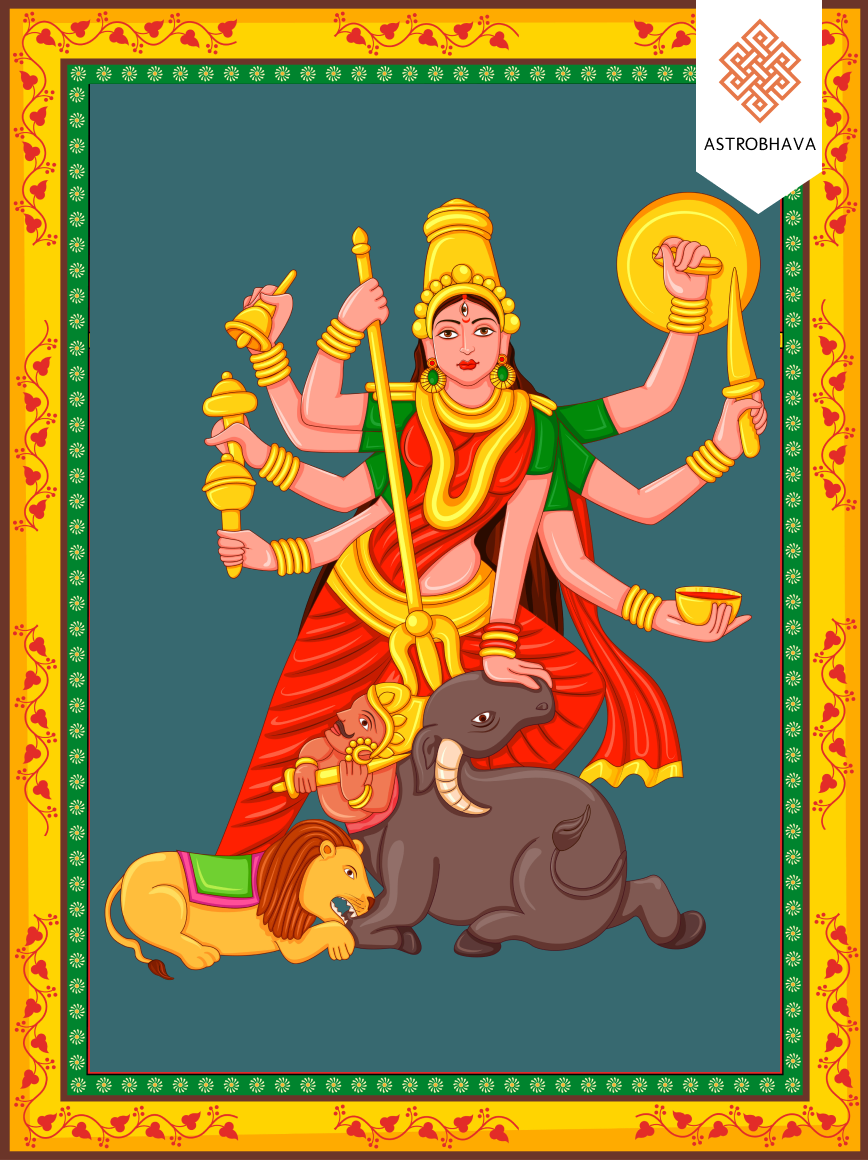
Swayamvara Parvathi is Parvati remembered in the precise moment of her self-choice, when she places the garland upon Shiva in the assembly arranged by the gods. The compound name joins swayamvara, the ancient royal rite in which a bride selects her husband, with Parvathi, daughter of Himavan. South Indian mantra handbooks isolate this aspect under the address Yogini Yogeshwari, distinguishing her from both the unmarried tapasvini of the mountain and the later domestic Gauri. The Shiva Purana and the Kumarasambhava supply the narrative background: after the destruction of Kama, the gods petition for a bride who can bear Shiva’s energy, and the swayamvara becomes the public recognition of a choice Parvati has already made in her heart. She is therefore the Goddess of the deliberate, publicly affirmed union rather than of generic marital fortune.
Parvati’s public choice of Shiva
According to the Shiva Purana, after Kama is burned and the gods grow anxious for a son who can defeat Taraka, they approach Himavan and request that his daughter be given to Shiva. Parvati has already been performing austerities to win the ascetic lord; the formal swayamvara is convened so that her choice may be witnessed by the divine assembly. In Kalidasa’s Kumarasambhava the same moment is rendered with poetic fullness: the palace is prepared, the suitors are present in their splendour, yet Parvati’s gaze and garland turn only toward the three-eyed god who arrives in deceptively humble guise. The mantra traditions of South India crystallise this episode into the epithets Yogini and Yogeshwari, addressing the Goddess who both practises yoga and governs it, and who brings every circumstance under the sway of that chosen union. No other form of Parvati is invoked through this exact cluster of names tied to the swayamvara scene.
The mantra, in six scripts
The seed mantra, and the form most devotees chant daily. No initiation is required — it is open to anyone, including a parent chanting for a child.
Malayalamഓം ഹ്രീം യോഗിനി യോഗേശ്വരി യോഗഭയംകരി സകലസ്ഥാനം വശീകുരു കുരു സ്വാഹാ
EnglishRoman transliterationoṃ hrīṃ yogini yogeśvari yogabhayaṃkari sakalasthānaṃ vaśīkuru kuru svāhā
“Om, Hrīm, O Yogini, O mistress of yoga, O you who make yoga formidable, bring every place under sway, bring it under sway, Svāhā.”
ॐ
oṃ — Om
ह्रीं
hrīṃ — the seed-syllable Hrīm
योगिनि
yogini — O Yogini
योगेश्वरि
yogeśvari — O mistress of yoga
योगभयंकरि
yogabhayaṃkari — O you who make yoga formidable
सकलस्थानं
sakalasthānaṃ — every place
वशीकुरु
vaśīkuru — bring under sway
कुरु
kuru — bring about
स्वाहा
svāhā — Svāhā
Aim is the mantra, in a sense. The rest is address and salutation; the seed syllable carries the goddess. Where a practitioner has been given a very short practice, it is often Aim alone.
The syllable people get wrong
In yogeśvari the syllable śva is often misread as a simple sva or even shwa, so the name becomes “yoga-svari” or “yogesh-wari” with an English w; the correct palatal ś followed by the labial v must be kept distinct, otherwise the title “mistress of yoga” loses its Sanskrit contour.
When Swayamvara Parvathi is chanted
Weekday. Friday
Questions
Within this mantra Yogeshwari names her as the sovereign of yoga who has already mastered the austerities that win Shiva; it is not a generic epithet but the specific address used for her swayamvara aspect.
The Shiva Purana and the poetic retelling in the Kumarasambhava give the fullest public assembly; other texts emphasise her prior tapas and treat the formal choice as confirmation rather than first decision.
The phrase sakalasthānaṃ vaśīkuru belongs to the yogic vocabulary of the formula; it refers to the Goddess’s capacity to align all circumstances with the union she has chosen, not to a general promise of control.
Not sure a mantra is enough?
Have your chart read before you decide
Chanting is yours to do, and free. But which deity your situation calls for — and whether a mantra alone is the right response — depends on your chart. Sometimes it is; sometimes it is not.
Brahmashree Shivaaya
Guru, Head of Astrological & Spiritual Solutions
Over 30 years in the Guru–Sishya Parampara, from the age of five
He reads every chart himself — 60 minutes, one to one, never delegated
Charts are read only between sunrise and sunset, following tradition
Chanting is yours to do. Some things are performed for you.
Where a matter carries real weight — an examination that decides a course, a performance, a child whose studies have stalled — devotees sponsor the homa alongside their own practice. Performed individually at our Yagna Ashram in your name and gotra, on a muhurta calculated from your chart, and telecast live so you can watch it done for you.