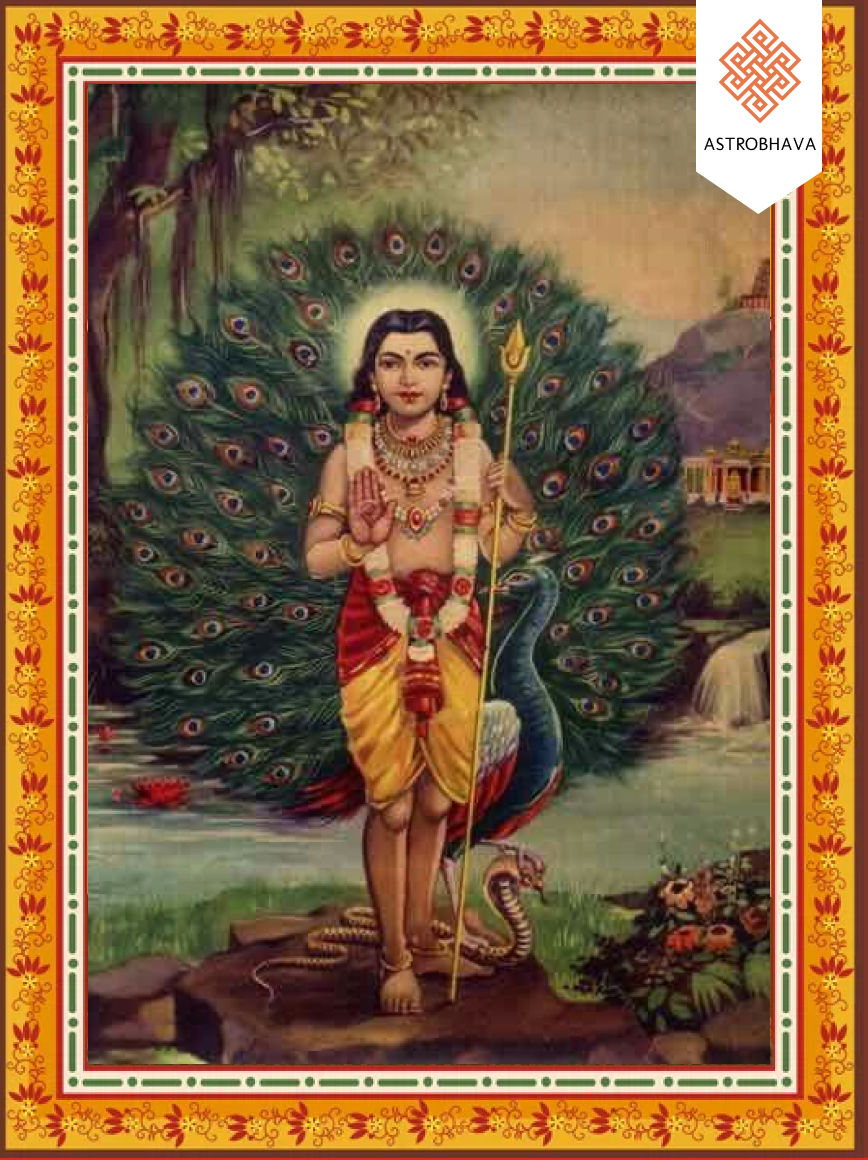
Mantra · The principal mantra. For courage and Mangal affliction.
Subrahmanya
ॐ सरवणभवाय नमः
In Devanagari, Tamil, Telugu, Kannada, Malayalam and English — with the meaning of every word, and the one syllable most people pronounce wrongly.
Who Subrahmanya is
Subrahmanya is the six-faced commander of the celestial armies, born of Shiva’s fiery essence and reared among the reeds of the celestial lake Saravana. In the Tamil country he is Murugan, the youthful spear-bearer whose shrines crown every hill from Tiruttani to Palani; in the Sanskrit puranas he is Skanda or Kartikeya, the son who received the lance called Vel from his mother and who alone could confront the asura Taraka. His form carries the peacock as vehicle and the rooster as banner, signs of vigilance and the conquest of darkness. Tradition places him as the deity who governs the planet Mars, yet his identity remains inseparable from the mountain landscapes and the fragrant forests where the Krittikas nursed him. Every epithet—Guha, the hidden one; Shanmukha, the six-faced—points to a single presence whose mythology never merges with that of any other god.
Birth among the reeds
The Skanda Purana and the earlier Kumara-sambhava of Kalidasa recount that Shiva’s accumulated tapas burst forth as six sparks of unbearable brilliance. Agni, unable to bear them, cast the sparks into the cool waters of Ganga; she in turn deposited them among the dense reeds of the lake Saravana. There the six infants took form and were suckled by the six Krittika stars. When Parvati gathered the children into one body, the boy retained six faces and twelve arms, receiving the name Saravanabhava, ‘he who arose in the reed thicket.’ The same texts describe how the gods, oppressed by Taraka, sought this child as their general. Brahma invested him with command, Indra offered his own spear, and the army of the devas marched under the peacock standard. The decisive battle on the southern ocean shore ended with Taraka’s fall, after which Subrahmanya took his seat upon the hills, forever linked to the place of his reed-born origin and to the martial charge entrusted to him alone.
The mantra, in six scripts
The seed mantra, and the form most devotees chant daily. No initiation is required — it is open to anyone, including a parent chanting for a child.
“Salutation to the one who came into being within the reed thicket.”
ॐ
oṃ — the primordial syllable
सरवणभवाय
saravaṇabhavāya — to the reed-thicket-born
नमः
namaḥ — salutation
Aim is the mantra, in a sense. The rest is address and salutation; the seed syllable carries the goddess. Where a practitioner has been given a very short practice, it is often Aim alone.
The syllable people get wrong
The retroflex ṇ in sara-va-ṇa is frequently flattened to a dental n, producing the incorrect sa-ra-va-na. Speakers must curl the tongue back for the ṇ before the following bha, otherwise the name of the reed lake itself is lost and the mantra no longer names the precise birthplace.
When Subrahmanya is chanted
Weekday. Tuesday
Festival. Skanda Shashti
Questions
The six faces commemorate the six sparks that fell into Saravana and the six Krittika mothers who nursed them. When Parvati embraced the infants they fused into one body yet kept the six countenances, each facing a cardinal or intermediate direction so that the commander of the divine host might survey every quarter of the battlefield at once. The Skanda Purana treats this multiplicity as unique to him; no other deity of the pantheon is described as retaining the separate faces of his own multiple births.
The peacock, called Paravani, is said in the southern Agamas to have been the form assumed by the asura Surapadman after his defeat. Subrahmanya spared the transformed demon and accepted him as mount, thereby turning the very force of opposition into the means of movement. The bird’s outspread tail mirrors the spread of the commander’s six faces, and its cry is held to announce the presence of the Vel. This association belongs exclusively to Subrahmanya’s cycle of myths and is not shared with any other deity who rides a bird.
Jyotisha texts identify Subrahmanya with Angaraka or Mangala because both embody the fiery, martial principle that arises from Shiva’s own tejas. The same sparks that became the child also kindled the red planet. Temples dedicated to him therefore observe Tuesday, the weekday of Mars, and the iconography sometimes places the planet’s symbol near the Vel. The correspondence remains internal to his mythology and does not extend to other warlike figures who lack the reed-birth narrative.
Not sure a mantra is enough?
Have your chart read before you decide
Chanting is yours to do, and free. But which deity your situation calls for — and whether a mantra alone is the right response — depends on your chart. Sometimes it is; sometimes it is not.
Brahmashree Shivaaya
Guru, Head of Astrological & Spiritual Solutions
Over 30 years in the Guru–Sishya Parampara, from the age of five
He reads every chart himself — 60 minutes, one to one, never delegated
Charts are read only between sunrise and sunset, following tradition
Chanting is yours to do. Some things are performed for you.
Where a matter carries real weight — an examination that decides a course, a performance, a child whose studies have stalled — devotees sponsor the homa alongside their own practice. Performed individually at our Yagna Ashram in your name and gotra, on a muhurta calculated from your chart, and telecast live so you can watch it done for you.