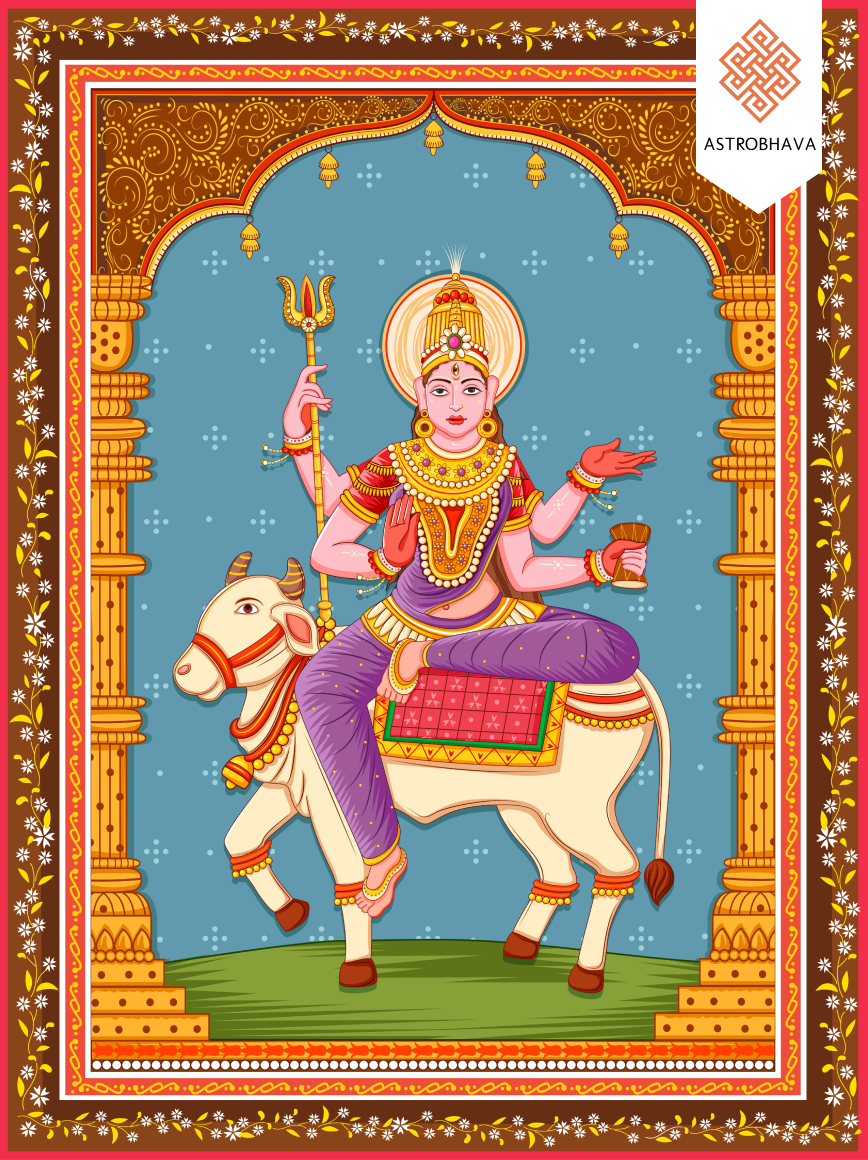
Mantra · For married life and the wellbeing of a spouse.
Mangala Gauri
ॐ ह्रीं श्रीं मंगलगौर्यै नमः
In Devanagari, Tamil, Telugu, Kannada, Malayalam and English — with the meaning of every word, and the one syllable most people pronounce wrongly.
Who Mangala Gauri is
Mangala Gauri is the auspicious face of Parvati honoured in the household rites of married women across Maharashtra, northern Karnataka and adjoining Deccan regions. Her name joins mangala, the quality of well-being and good fortune, with Gauri, the radiant consort of Shiva. She is approached not as a warrior but as the steady presence that guards the saubhagya of a living husband and the quiet order of the home. Regional mahatmyas and the later layers of the Skanda Purana describe her seated images, often two-armed or four-armed, holding lotus and gesture of blessing, her complexion fair. Tuesday of the bright fortnight in the month of Shravana is her special season, when women gather to retell her vrat-katha and offer turmeric and vermilion. She is thereby distinguished from fierce or unmarried forms of the Goddess by this exclusive concern with the married state already entered.
The Shravana Tuesday vow
Oral and printed vrat-katha collections current in the Deccan recount that Parvati herself once observed a series of Tuesdays in Shravana to secure lasting mangala for her union with Shiva. In one widely told version a princess named Shubhamangala, whose marriage had been delayed by planetary affliction, is instructed by a wandering ascetic to honour Gauri on sixteen successive Tuesdays with sixteen kinds of grain and sixteen lamps. At the conclusion of the vow the obstacles dissolve and her wedding is celebrated. Another strand, preserved in Marathi and Kannada pamphlets, tells of a poor Brahmin wife who continues the same Tuesday observance even when rice is scarce; Gauri appears in a dream, fills the granary, and restores the health of the husband. These narratives are not found in the early Sanskrit Puranas in this exact form; they belong to the living regional tradition that has fixed Mangala Gauri as the deity of the Shravana Tuesday vow and of the married woman’s ongoing well-being.
The mantra, in six scripts
The seed mantra, and the form most devotees chant daily. No initiation is required — it is open to anyone, including a parent chanting for a child.
Aim is the mantra, in a sense. The rest is address and salutation; the seed syllable carries the goddess. Where a practitioner has been given a very short practice, it is often Aim alone.
The syllable people get wrong
The velar nasal ṅ in maṅgala is commonly replaced by an ordinary dental n, yielding “man-gala” instead of the correct maṅ-ga-la; the loss of the ṅ sound also shortens the first syllable and severs the word from its auspicious Sanskrit root.
When Mangala Gauri is chanted
Weekday. Friday
Festival. Mangala Gauri Vrat on Tuesdays of Shravana
Questions
In the Deccan vrat tradition the weekday of Mangala (Tuesday) is itself regarded as her namesake day; the observance is therefore fixed to the Tuesdays that fall inside the month of Shravana, independent of tithi.
The Gauri of Ganesh Chaturthi arrives as mother of Ganesha for a short domestic visit; Mangala Gauri is invoked throughout married life, especially on Shravana Tuesdays, for the continuing saubhagya of the husband.
The number sixteen and the detailed grain offerings appear in regional Marathi and Kannada vrat-katha booklets rather than in the core Sanskrit Puranic text; they belong to the living practice that has shaped her cult.
Not sure a mantra is enough?
Have your chart read before you decide
Chanting is yours to do, and free. But which deity your situation calls for — and whether a mantra alone is the right response — depends on your chart. Sometimes it is; sometimes it is not.
Brahmashree Shivaaya
Guru, Head of Astrological & Spiritual Solutions
Over 30 years in the Guru–Sishya Parampara, from the age of five
He reads every chart himself — 60 minutes, one to one, never delegated
Charts are read only between sunrise and sunset, following tradition
Chanting is yours to do. Some things are performed for you.
Where a matter carries real weight — an examination that decides a course, a performance, a child whose studies have stalled — devotees sponsor the homa alongside their own practice. Performed individually at our Yagna Ashram in your name and gotra, on a muhurta calculated from your chart, and telecast live so you can watch it done for you.