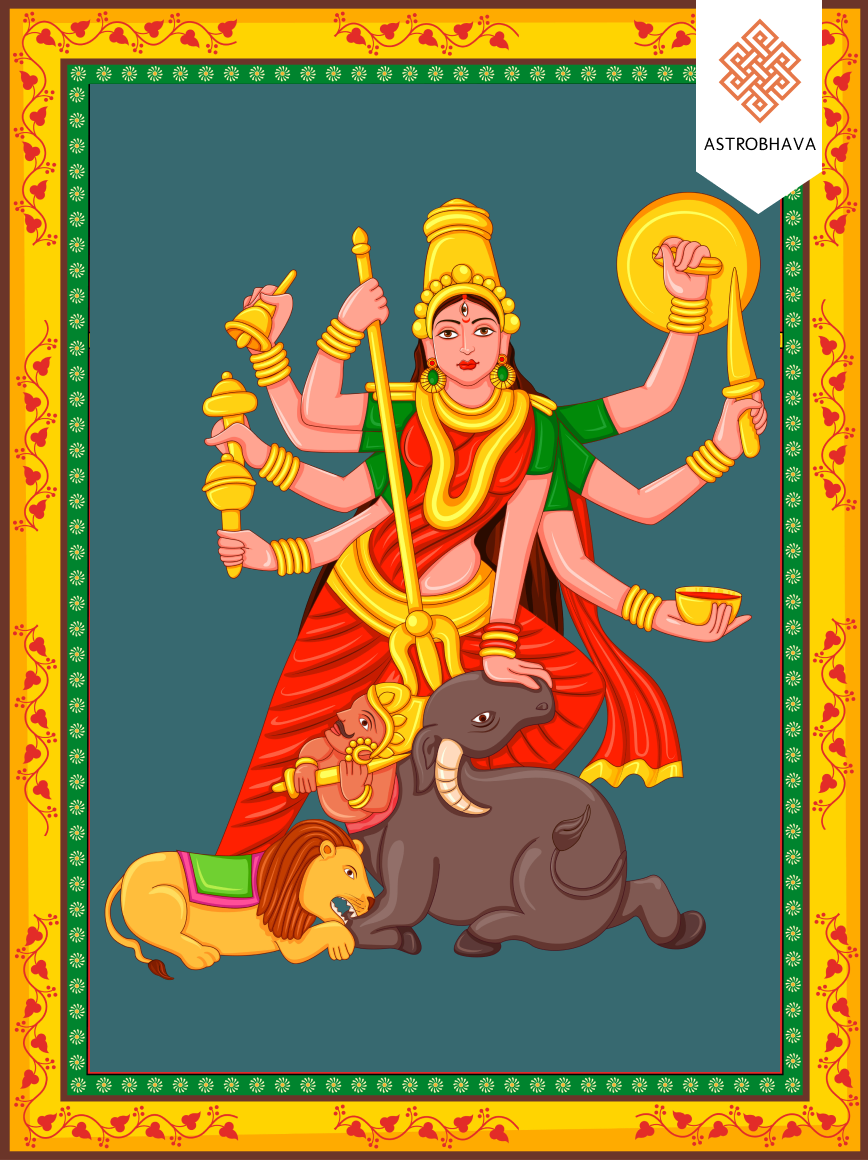
Mantra · For marriage and the fulfilment of desire.
Kamakshi
ॐ कामाक्ष्यै नमः
In Devanagari, Tamil, Telugu, Kannada, Malayalam and English — with the meaning of every word, and the one syllable most people pronounce wrongly.
Who Kamakshi is
Kamakshi is the Goddess of the temple at Kanchipuram in Tamil Nadu, regarded as one of the three great seats of the Divine Mother alongside Madurai Meenakshi and Kashi Vishalakshi. Her name joins kama, desire or longing, with akshi, eye, so that she is she whose eyes are desire, or she who regards the devotee with the glance that fulfils. Iconographically she sits in the lotus posture, four-armed, bearing the goad, noose, sugarcane bow and flower-arrows of Sri Vidya’s Tripura Sundari, yet her particular presence is inseparable from the Kanchi soil. The Kamakoti Peetha tradition holds that Adi Shankaracharya established a Sri Chakra before her image, converting an earlier fierce aspect into the gracious form now worshipped. She is thus both the local amman of the Pallava and Chola country and a full embodiment of the transcendent Lalita whose glance orders the world.
Penance in the Mango Grove
Local tradition recorded in the Kamakshi Vilasa and in the sthalapuranas of Kanchipuram tells that the Goddess came to the earth in order to marry Shiva. She performed severe austerities in a mango grove at Kanchi, standing on a single needle or, in other tellings, on the tip of her toe, until Shiva was compelled to appear and accept her. In one version she fashioned a linga of sand and worshipped it; when the river flooded she protected it with her own body, and Shiva, moved by that devotion, granted her wish. Another strand links her to the re-establishment of dharma after a period when the gods had lost their power; her glance alone restored order. The temple image is understood to be self-manifest, and the Sri Chakra installed by Shankara is said to hold her power in a stable, benevolent form so that the same glance that once burned with tapas now rests as compassion upon the city and its surrounding country.
The mantra, in six scripts
The seed mantra, and the form most devotees chant daily. No initiation is required — it is open to anyone, including a parent chanting for a child.
DevanagariSanskrit & Hindiॐ कामाक्ष्यै नमः
Tamilௐ காமாக்ஷ்யை நமஃ
Teluguఓం కామాక్ష్యై నమః
Kannadaಓಂ ಕಾಮಾಕ್ಷ್ಯೈ ನಮಃ
Malayalamഓം കാമാക്ഷ്യൈ നമഃ
EnglishRoman transliterationoṃ kāmakṣyai namaḥ
“Om, salutations to Kamakshi.”
ॐ
oṃ — the primordial syllable
कामाक्ष्यै
kāmakṣyai — to Kamakshi, she whose eyes are desire
नमः
namaḥ — salutations
Aim is the mantra, in a sense. The rest is address and salutation; the seed syllable carries the goddess. Where a practitioner has been given a very short practice, it is often Aim alone.
The syllable people get wrong
The cluster kṣy in kāmakṣyai is a frequent stumbling point. Speakers commonly simplify it to a single kshi as in the modern pronunciation of the name, omitting the distinct y-glide that follows the retroflex ṣ. The traditional sound requires the tongue to strike for ṣ and then immediately release into y before the dative ai, yielding kṣyai rather than a flattened kshi.
When Kamakshi is chanted
Weekday. Friday
Festival. Brahmotsavam of the Kanchipuram Kamakshi temple
Questions
Kanchipuram is her primary seat. The temple sthalapurana and the Kamakoti tradition identify the present image and the land itself as the place where she performed penance to obtain Shiva as husband and where her power remains permanently established.
Her attributes—the sugarcane bow, the five flower arrows, the noose and goad—are identical with those of Lalita Tripura Sundari. In the Sri Vidya understanding current at Kanchi she is regarded as that same goddess in her local, gracious manifestation.
Akshi means eye. The name Kamakshi indicates that desire, or the fulfilment of longing, is transmitted through her glance. Iconographic descriptions and temple hymns repeatedly return to the quality of those eyes as the means by which she regards the world.
Not sure a mantra is enough?
Have your chart read before you decide
Chanting is yours to do, and free. But which deity your situation calls for — and whether a mantra alone is the right response — depends on your chart. Sometimes it is; sometimes it is not.
Brahmashree Shivaaya
Guru, Head of Astrological & Spiritual Solutions
Over 30 years in the Guru–Sishya Parampara, from the age of five
He reads every chart himself — 60 minutes, one to one, never delegated
Charts are read only between sunrise and sunset, following tradition
Chanting is yours to do. Some things are performed for you.
Where a matter carries real weight — an examination that decides a course, a performance, a child whose studies have stalled — devotees sponsor the homa alongside their own practice. Performed individually at our Yagna Ashram in your name and gotra, on a muhurta calculated from your chart, and telecast live so you can watch it done for you.