In Devanagari, Tamil, Telugu, Kannada, Malayalam and English — with the meaning of every word, and the one syllable most people pronounce wrongly.
Who Gayatri Devi is
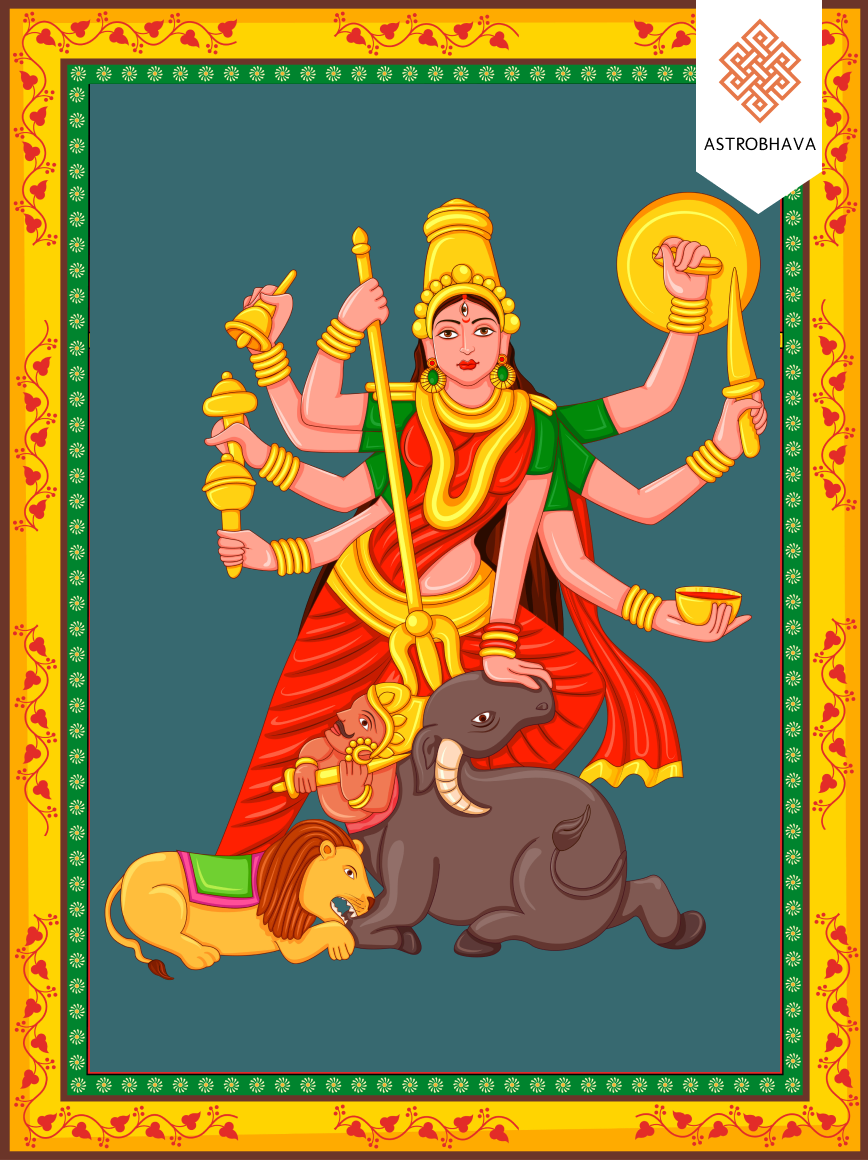
Gayatri Devi is the Veda-Mata, the mother of the Vedas in personified form, the goddess whose body is understood to be the twenty-four syllables of the Gayatri mantra itself. She is described in the later Puranic and Tantric layers as five-faced and ten-armed, each face corresponding to a Veda or to an aspect of sacred knowledge, seated on a lotus or on a swan. Where the mantra is the audible revelation, Gayatri Devi is that revelation given a face, a gaze, and a maternal identity. She is not merely a deity to whom the mantra is addressed; she is the mantra’s own luminous person. Worshippers therefore approach her as the source from which the three Vedic vyahritis and the Savitri verse continually arise, the goddess who holds within herself the light of Savitar that the verse contemplates.
When the Mantra Took Form
The Devi Bhagavata Purana and related Shakta passages recount that the Gayatri mantra, long recited by sages as pure sound, once desired to be seen. At the request of the rishis, the luminous power within the verse condensed into the form of a goddess with five heads—one for each Veda and one for the Mahabharata tradition—and ten arms bearing the weapons and emblems of knowledge. In another strand preserved in the Agni Purana and in Smarta ritual manuals, Brahma himself is said to have beheld Gayatri Devi rising from the sacrificial fire when the metre and the deity of the sun were invoked together. She then instructed the assembled sages that the twenty-four syllables were her own limbs and that meditation on the mantra was identical with meditation on her form. These accounts do not treat her as a later invention; they present the personified goddess as the eternal inner reality of the verse that opens the daily sandhya rites. Thus Gayatri Devi stands as both the mother who gives birth to Vedic speech and the speech that has taken a mother’s shape.
The mantra, in six scripts
The seed mantra, and the form most devotees chant daily. No initiation is required — it is open to anyone, including a parent chanting for a child.
EnglishRoman transliterationoṃ bhūr bhuvaḥ svaḥ tat savitur vareṇyaṃ bhargo devasya dhīmahi dhiyo yo naḥ pracodayāt
“Om. Earth, mid-space, heaven. Let us contemplate that excellent splendour of the god Savitar; may he impel our insights.”
ॐ
oṃ — the sacred syllable
भूः
bhūḥ — earth
भुवः
bhuvaḥ — mid-space
स्वः
svaḥ — heaven
तत्
tat — that
सवितुः
savituḥ — of Savitar
वरेण्यम्
vareṇyam — excellent, to be desired
भर्गः
bhargaḥ — splendour, radiance
देवस्य
devasya — of the god
धीमहि
dhīmahi — let us contemplate
धियः
dhiyaḥ — insights, thoughts
यः
yaḥ — who
नः
naḥ — our
प्रचोदयात्
pracodayāt — may he impel
Aim is the mantra, in a sense. The rest is address and salutation; the seed syllable carries the goddess. Where a practitioner has been given a very short practice, it is often Aim alone.
The syllable people get wrong
In vareṇyaṃ the retroflex ṇ is followed immediately by the palatal ya, forming the conjunct ṇya. Speakers often reduce it to a simple “nya” with a dental n, saying “varenyam” as if the nasal were ordinary. The tongue must strike the retroflex position before releasing into ya; otherwise the precise Vedic contour of the goddess’s own metre is lost.
When Gayatri Devi is chanted
Weekday. Friday
Festival. Gayatri Jayanti, observed on the Shukla Ekadashi of Jyeshtha in many North Indian calendars
Questions
In the tradition that personifies her, the twenty-four syllables are regarded as her own limbs. The mantra is not merely addressed to her; it is her audible body. Contemplating the verse is therefore understood as contemplating the goddess who is the Veda-Mata.
Iconographic and Puranic descriptions assign one face to each of the four Vedas and a fifth to the extended tradition of sacred narrative and auxiliary knowledge. The five faces together signify that all branches of Vedic speech arise from and return to her single maternal form.
The verse contemplates the bhargas, the radiant splendour, of the god Savitar. Gayatri Devi is the personified power of that contemplation; she is the mother through whom the solar impulse toward clear insight is made present to the reciter.
Not sure a mantra is enough?
Have your chart read before you decide
Chanting is yours to do, and free. But which deity your situation calls for — and whether a mantra alone is the right response — depends on your chart. Sometimes it is; sometimes it is not.
Brahmashree Shivaaya
Guru, Head of Astrological & Spiritual Solutions
Over 30 years in the Guru–Sishya Parampara, from the age of five
He reads every chart himself — 60 minutes, one to one, never delegated
Charts are read only between sunrise and sunset, following tradition
Chanting is yours to do. Some things are performed for you.
Where a matter carries real weight — an examination that decides a course, a performance, a child whose studies have stalled — devotees sponsor the homa alongside their own practice. Performed individually at our Yagna Ashram in your name and gotra, on a muhurta calculated from your chart, and telecast live so you can watch it done for you.