Mantra · For protection and courage against opposition.
Durga
ॐ दुं दुर्गायै नमः
In Devanagari, Tamil, Telugu, Kannada, Malayalam and English — with the meaning of every word, and the one syllable most people pronounce wrongly.
Who Durga is
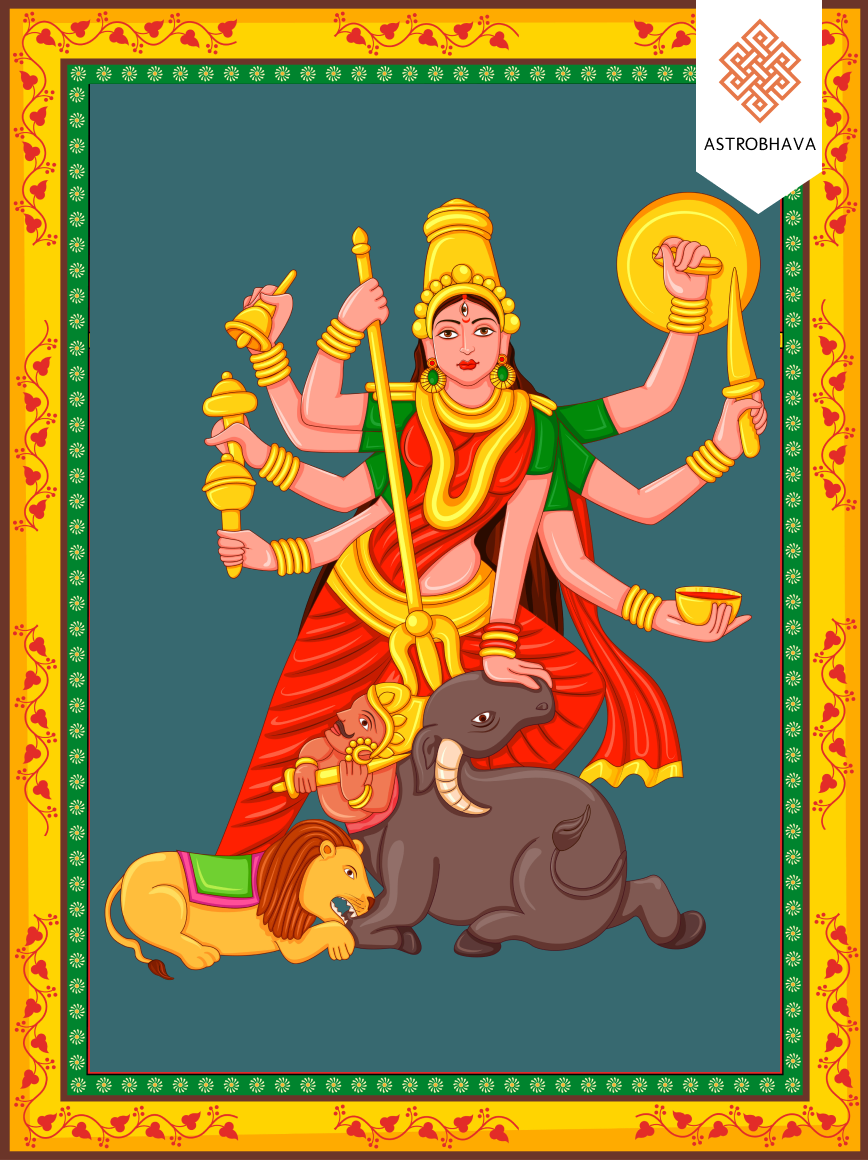
Durga is the sovereign goddess who rises when the combined radiance of the gods is poured into a single form to meet a crisis no male deity can resolve. In the Markandeya Purana she is called the inaccessible one, the fortress that cannot be scaled, whose very name signals the difficulty of approach for any force that opposes dharma. She is not portrayed as a consort waiting upon a husband but as an independent shakti who accepts the weapons of Vishnu, Shiva, and Indra and then acts alone. Her lion is the mount of uncompromising will; her many arms hold the discus, trident, bow, and sword that once belonged to the celestials. Iconography across Bengal, the Vindhyas, and the Tamil country shows her left foot pressed upon the buffalo demon while her face remains composed, neither triumphant nor cruel. She is the mother who both shelters and severs.
Birth against Mahishasura
The Devi Mahatmya, embedded in the Markandeya Purana, recounts that the buffalo demon Mahishasura had obtained a boon rendering him invulnerable to any male. He drove the gods from heaven and ruled the three worlds. In despair the deities gathered their energies; from the blaze of their combined tejas a radiant woman took shape. Vishnu gave her the discus, Shiva the trident, Varuna the conch, Agni the spear, and Himavan the lion. Thus armed, Durga challenged Mahishasura on the field. The demon shifted forms—buffalo, lion, elephant, man—yet each shape was cut down. When he finally sprang at her as a buffalo, she pinned him with her foot, pierced his neck with the trident, and severed the emerging human head. The gods praised her as Mahishasura-mardini, the one who restores the order the asura had overturned. The episode is recited each autumn as the core narrative of her sovereignty.
The mantra, in six scripts
The seed mantra, and the form most devotees chant daily. No initiation is required — it is open to anyone, including a parent chanting for a child.
DevanagariSanskrit & Hindiॐ दुं दुर्गायै नमः
Tamilௐ தும் துர்காயை நமஃ
Teluguఓం దుం దుర్గాయై నమః
Kannadaಓಂ ದುಂ ದುರ್ಗಾಯೈ ನಮಃ
Malayalamഓം ദും ദുര്ഗായൈ നമഃ
EnglishRoman transliterationoṃ duṃ durgāyai namaḥ
“Salutation to Durga, addressed through her seed-syllable dum.”
ॐ
oṃ — the primal syllable
दुं
duṃ — seed-syllable of Durga
दुर्गायै
durgāyai — to Durga (dative)
नमः
namaḥ — salutation
Aim is the mantra, in a sense. The rest is address and salutation; the seed syllable carries the goddess. Where a practitioner has been given a very short practice, it is often Aim alone.
The syllable people get wrong
The seed-syllable duṃ is routinely flattened into the English word “dumb,” stripping away the anusvāra’s soft-palate hum that should linger before the lips open. Equally common is the collapse of the long ā in durgāyai into a hurried schwa, so the dative ending loses the open, held quality that marks the name as a formal address rather than a casual label.
When Durga is chanted
Weekday. Friday
Festival. Navaratri and Durga Puja
Questions
The Devi Mahatmya presents her emergence as the moment when individual divine powers prove insufficient against a boon that excludes male combatants; only their gathered radiance can produce a form outside that restriction.
It denotes both the fortress that cannot be taken and the one who is difficult of access, underscoring that approach to her is not casual but requires the recognition of her independent sovereignty.
Traditional iconographic comment holds that the calm face shows the act as restoration of balance rather than personal anger; the violence is precise, not passionate.
Not sure a mantra is enough?
Have your chart read before you decide
Chanting is yours to do, and free. But which deity your situation calls for — and whether a mantra alone is the right response — depends on your chart. Sometimes it is; sometimes it is not.
Brahmashree Shivaaya
Guru, Head of Astrological & Spiritual Solutions
Over 30 years in the Guru–Sishya Parampara, from the age of five
He reads every chart himself — 60 minutes, one to one, never delegated
Charts are read only between sunrise and sunset, following tradition
Chanting is yours to do. Some things are performed for you.
Where a matter carries real weight — an examination that decides a course, a performance, a child whose studies have stalled — devotees sponsor the homa alongside their own practice. Performed individually at our Yagna Ashram in your name and gotra, on a muhurta calculated from your chart, and telecast live so you can watch it done for you.