Homas are being performed LIVE at our Yagna Ashram — watch today's ceremonies
HomeHomaSpiritual Growth & Devotion › Rudrashtakam Homa
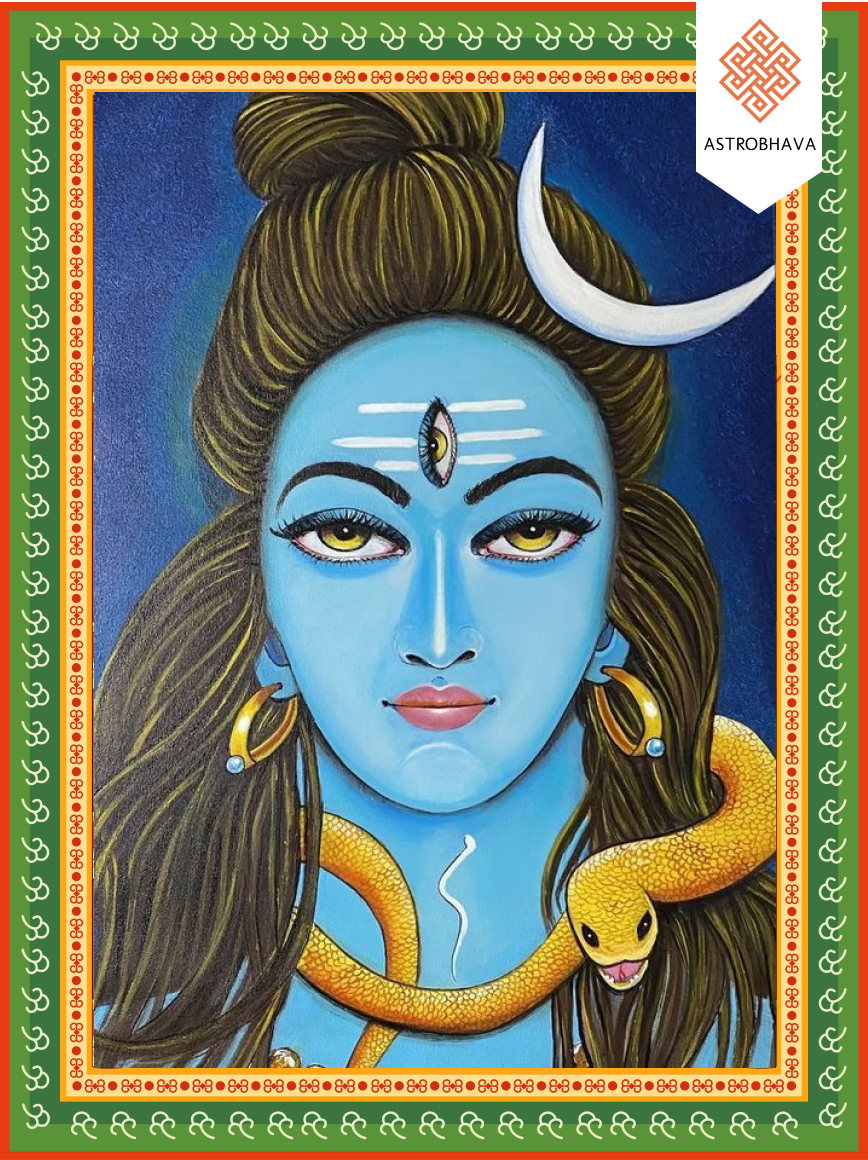
Telecast Live Rudra, the deity invoked in the Rudrashtakam Homa at AstroBhava
Spiritual Growth & Devotion · maha Homa · Live from our Yagna Ashram

Rudrashtakam Homa

Also spelled Rudrashtakam Homam

रुद्राष्टकम् होम

Eight verses of pure praise, offered into fire for you — that the mind grow still and Shiva's grace draw near.

  • Performed for you alone — never a group ceremony
  • Muhurta fixed from your own birth chart, confirmed within 24–48 working hours
  • Free energised yantra, sealed in a silver amulet, shipped worldwide at no charge
The Ritual and Its Weight

The Rudrashtakam is Goswami Tulsidas's eight-verse hymn to Rudra — the auspicious one, formless, beyond the reach of the senses, worshipped by sages and by the simplest heart alike. In the Rudrashtakam Homa, those verses are not merely recited. They are offered. Each stanza is carried into the fire with ghee and sacred wood, so that praise itself becomes oblation and the sound of Shiva's names fills the mandapa.

Tradition places this rite among the offerings made for the inner life — for the seeker who wants devotion to deepen, for the household that wants quiet after a long unsettled season, for the mind that has grown restless and seeks a still centre. The hymn asks for nothing material. It only praises, and then pleads at the last: have mercy on me. That is the weight of the Rudrashtakam Homam. It teaches the heart to want the Lord and nothing else.

नमामीशमीशान निर्वाणरूपं विभुं व्यापकं ब्रह्मवेदस्वरूपम् । निजं निर्गुणं निर्विकल्पं निरीहं चिदाकाशमाकाशवासं भजेऽहम् ॥ I bow to the Lord of all, whose very form is liberation, all-pervading, the essence of the Vedas — self-existent, beyond qualities, beyond change, beyond desire; I worship him who is the sky of pure consciousness and who dwells in that sky.

Why Devotees Book This

The tradition prescribes the Rudrashtakam Homa for these ends. Approach it as worship, not as transaction.

Deepening of devotion

Eight verses of unbroken praise, offered on your behalf, to soften the heart and turn it toward Shiva.

Inner stillness

Prescribed for the restless mind — a rite traditionally taken up when thought will not settle and quiet is sought.

Divine grace

The hymn closes by asking Rudra for mercy alone. Devotees offer it seeking that grace, in whatever form it comes.

Purification of intent

Fire is offered so that lower urges, resentment and clouded motive are surrendered along with the ghee.

Strength on the sadhana path

Taken up by seekers at the start of japa, vrata or a new discipline, asking that the practice hold.

Peace in the household

Families book the Rudrashtakam Homam for a settled atmosphere at home and steadiness through difficult stretches.

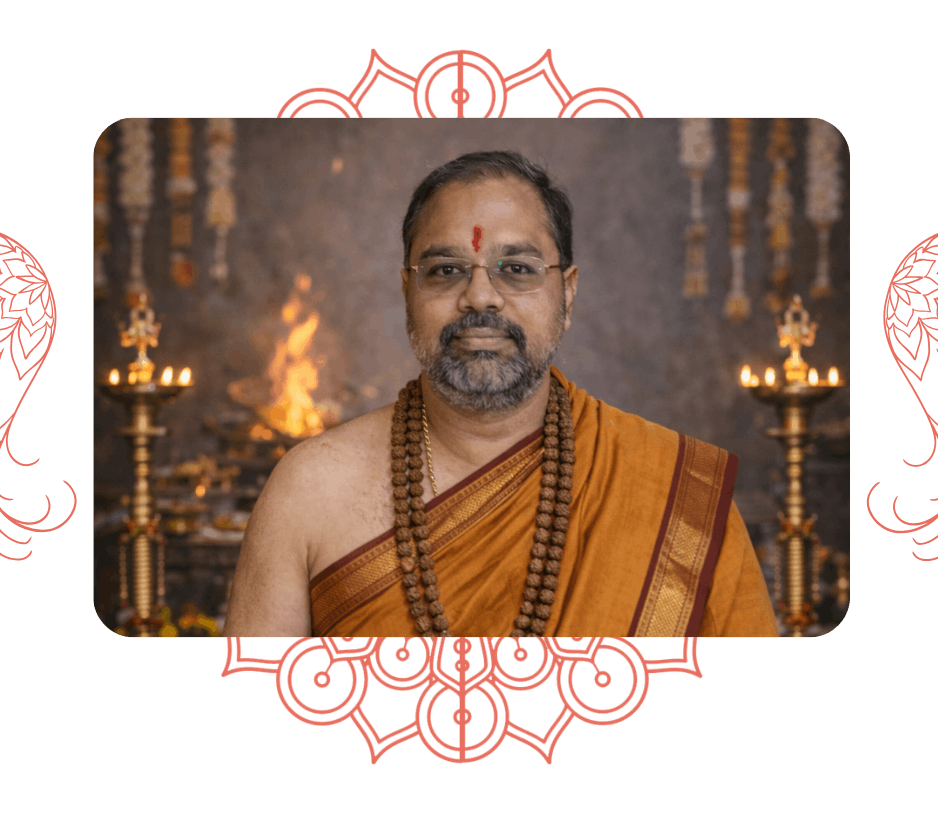
Brahmashree Shivaaya, Guru and Head of Astrological & Spiritual Solutions at AstroBhava
Brahmashree ShivaayaGuru, Head of Astrological & Spiritual Solutions
Who performs your homa

Under the guidance of Brahmashree Shivaaya

Every priest who performs your Rudrashtakam Homa is trained in a traditional Padashala and personally recruited by Brahmashree Shivaaya — Guru and Head of Astrological & Spiritual Solutions at AstroBhava. Your ritual is conducted at our own Yagna Ashram — never a rented venue — with temple rites performed across our seven temples in Tamil Nadu and Kerala.

Meet our priests →
Before you book

What a Maha Homa is

Not every fire ritual is performed at the same scale. A Maha Homa is our largest form. This is what that means.

Performed at full scale

More priests, and a fire that burns for as long as the rite itself requires rather than a shortened sitting. The exact figures for this rite are stated with its price above.

Chanted complete

The whole sequence the rite calls for, in unison, never a representative portion of it and never chanted in rotation.

Telecast entire

Every minute, from the sankalpa in which your name is spoken to the final aarti. Nothing is performed off camera.

A Maha Homa is performed for one devotee and their named family, exactly like any homa we conduct. What the scale changes is the weight of the offering, and it is reserved for the intentions that warrant it.

Book your Rudrashtakam Homa

One rite, one price

There is nothing to choose. Unlike most of our homas, the Rudrashtakam Homa is not offered at several priest counts. It is performed one way, as the rite requires — 5 priests, 5 hours — with the free energised Vishnu Yantra sealed in its silver amulet, the live telecast, and free worldwide delivery of your prasadam all included in the one price.

Your bookingRudrashtakam Homa5 Priests · 5 hours · free energised yantra
₹197,350

All-inclusive — no shipping charges, no additions at checkout. See everything included →

1

You book — and send birth details at checkout.

2

Within 24–48 working hours — your muhurta is confirmed by email.

3

The day before — your telecast link arrives by email.

4

After the homa — tracking email with your personal time to wear the yantra.

Sacred Timing

Any day may be given to Shiva, yet these occasions are held especially fit for the Rudrashtakam Homa. Tell us your preference and our priests will fix the muhurat.

Monday (Somavara)

The weekday of Shiva. Mondays, and Sravana Mondays above all, are the customary choice for this homa.

Pradosham

The twilight hour of the thirteenth tithi, twice each lunar month, when Shiva is worshipped in his dancing form.

Maha Shivaratri and monthly Shivaratri

The great night of Shiva, and its monthly return — held the most fruitful occasion for offerings to Rudra.

Ardra nakshatra

The star of Rudra himself. Ardra days, and the Ardra of Margazhi in particular, are chosen by many devotees.

Every package, and the 48-day option

What you receive

The sealing of the yantra

When your homa concludes, the yantra that stood in the fire is rolled and locked inside its silver amulet according to Agama vidhi — the practice by which the energies raised in a ritual are held within a consecrated object rather than dispersing. It is why a homa performed at our ashram can still reach a devotee ten thousand miles away: what the fire raised travels to you, sealed.

Personal sankalpa

Your name, gotra & nakshatra — for you and up to five family members.

Live telecast

Watch your own homa in real time from the ashram. Streamed openly on our YouTube channel by default — or request a private, unlisted telecast at checkout.

Free energised Rudra Yantra, sealed in a silver amulet

Consecrated over three days — Jala (holy-water consecration with mantras), Prana (life force through pranayama & chants) and Jeeva Pratishta (awakened with 108 recitations & offerings) — then present through your homa, receiving the energies raised in the fire. Immediately afterwards it is rolled and sealed inside a silver amulet by Agamic rite, locking those energies within, and shipped to you with your prasadam.

Prasadam, shipped free

Sacred vibhuti, sandalwood powder & kumkum from your fire — delivered to any country.

48-Day Anushthan (optional)

Daily temple worship for 48 days — the 27 Nakshatras + 12 Rashis + 9 Planets — then sealed in a silver amulet of approximately 2–4 inches.

A note on sacred tradition

As per strict Agama vidhi, no videography is permitted inside the temple sanctum — this preserves the pure sacred energies and undisturbed divine focus of the ritual. The main homa is respectfully telecast live from outside the sanctum; the daily rituals of the 48-day Anushthan are performed with full devotion but are not telecast.

Homas are telecast openly on our YouTube channel so that devotees everywhere may witness the rituals — and because we believe you should be able to see our work before you trust us with yours. Your sankalpa names you and your family, so if you would rather your ceremony were not public, choose the private telecast option at checkout and it is streamed as an unlisted link visible only to you.

We state this plainly — transparency about what tradition forbids filming, and about what is public, is part of performing these rituals honestly.

After it arrives

How to wear your energised Rudra Yantra

The energised yantra is carefully rolled and sealed inside a sacred silver amulet before shipping. Wearing it is itself a small ritual — and even its timing is set for you personally.

01

Your auspicious time to wear it

Our astrologer marks the auspicious date and time to wear the yantra according to your birth details — sent to you in the email carrying your shipment's tracking number.

02

Purify the amulet

Dip the silver amulet in raw milk or Ganga jal for an hour before wearing, then clean with normal water.

03

Face East or North

Perform the wearing process facing east or north for maximum benefit.

04

Offer dheep & dhoop

Show lamp and incense to the amulet before wearing it.

05

Wear it

Around your neck or waist, on a thread or chain.

06

Keep the energy intact

Repeated offering of dheep and dhoop keeps the energisation alive.

07

If you prefer not to wear it

Place the amulet at your puja altar, or keep it in your wallet.

Inside the fire ritual

How your Rudrashtakam Homa is performed

01

Sankalpa

The priest states your name, gotra and nakshatra — and those of up to five family members — with the intention this homa is performed for.

02

Ganapati Puja

The customary invocation to Ganapati, clearing obstacles before the goddess is approached.

03

Agni Pratishtha

The fire is consecrated in the homa kunda and Agni invoked as the carrier of every offering that follows.

04

Rudra Avahana

The Rudra Sukta and Rudra Gayatri are chanted, inviting the goddess's presence into the fire — by one, three or five priests as your package sets.

05

Ahuti

Ghee, white flowers, akshata and honey are offered in sequence with mantra — the offerings traditional to her worship.

06

Purnahuti

The final complete offering seals the sankalpa stated at the opening.

07

Aarti & Dispatch

Aarti is performed live on your telecast. Vibhuti, sandalwood powder, kumkum and your energised yantra are then packed and shipped free to your door.

Who is invoked

Rudra — the goddess of knowledge itself

Rudra is one of the Tridevi and the mother of the Vedas — the presiding deity of knowledge, learning, memory, speech, music and every art. She is depicted in white upon a white lotus, holding the veena, a book, a rosary and a water pot, with the swan of discernment beside her.

In this homa, her grace — Rudra Kataksham — is invoked through fire with your own name and birth details spoken in the sankalpa.

The complete guide

Rudra: story, mantras & how to chant

Her full mythology, the beeja mantra and Rudra Gayatri word by word, and how devotees chant at home — on our Rudra Mantra guide.

Read the Mantra Guide →
Not sure this is the right homa?

Ask before you book — free, or credited

Sarathi, our free AI ritual guide, recommends the traditional ritual for your situation instantly. For a full reading of your chart, book a live session with our astrologers — the fee is fully credited when you book any ritual.

Questions

Frequently asked

It is a Vedic fire ritual built around the Rudrashtakam, the eight-verse hymn to Lord Rudra composed by Goswami Tulsidas in the Ramcharitmanas. Priests chant the verses and offer ghee, samidha and sacred substances into the consecrated fire for each stanza. Its significance lies in what the hymn asks for: not wealth or victory, but mercy and nearness. It is offered for devotion, inner peace and Shiva's grace.
Tradition prescribes it for deepening bhakti, for a quieter and more collected mind, for purification of motive, for steadiness in spiritual practice, and for a peaceful household. Devotees also take it up at the beginning of a new sadhana. The rite is worship offered in faith; no outcome is promised, and the fruit is left to the Lord.
Anyone drawn to Shiva may sponsor it — there is no bar of caste, gender, age or country. Seekers on a devotional path, those passing through an unsettled season, families wanting peace at home, and devotees keeping Monday or Pradosham vratas commonly book the Rudrashtakam Homam. You need not know Sanskrit and you need not travel. Qualified priests perform it on your behalf at our Yagna Ashram.
Mondays, Pradosham evenings, Shivaratri and Maha Shivaratri, and Ardra nakshatra days are the traditional choices. Sravana month is especially favoured. Share your name, birth star and gotra when you book, and our priests will fix a suitable muhurat and confirm the date and time with you.
The priests begin with achamana, sankalpa taken in your name, gotra and birth star, and Ganapati puja for an unobstructed rite. Kalasha sthapana and Shiva avahana follow. Agni is kindled and consecrated, then the eight verses of the Rudrashtakam are chanted with ahutis for each. Samagri includes cow ghee, bilva leaves, palasha and other prescribed samidha, black and white sesame, rice, honey, dried fruit and havan dravya. The rite closes with purnahuti, deeparadhana and prayer for peace.
Book online from any country on this page. Give your name, gotra and birth star, and choose a date. Our priests perform the homa at our Yagna Ashram in Coimbatore and telecast it live to you, so you can sit in worship wherever you are. Prasadam and an energised yantra from the ritual are couriered to your address worldwide, free of shipping cost.
For knowledge, memory, speech & the arts

Let her name be spoken with yours

Book your Rudrashtakam Homa, watch it performed live from our Yagna Ashram, and receive your energised yantra anywhere in the world.

Choose Your Package
Trayi Rudrashtakam Homa3 Priests + Free Yantra · live telecast · individual sankalpa